Medically reviewed by Jeff Zhao, DO | Reviewed June 2026
I see a lot of patients in my Sunnyvale and Kaufman, Texas offices who arrive with the same story: deep shoulder pain that started after a hard fall, a collision on the field, or months of throwing or reaching overhead at work. They have had imaging done, and the report comes back mentioning a labral tear. So what is a labral tear in the shoulder? My goal with this post is to walk you through what the labrum actually does, how these tears happen, what they feel like, and what we can do about them.
Key Takeaways
- The labrum is a ring of cartilage that deepens the shoulder socket and helps stabilize the joint during movement.
- Labral tears can result from a single traumatic event, like a dislocation, or from repetitive overhead stress over time.
- Common symptoms include deep shoulder pain that is hard to pinpoint, a clicking or catching sensation, and a feeling that the joint may give way.
- Many patients respond well to physical therapy and activity modification. When symptoms persist, arthroscopic repair is often an effective path forward.
What Is the Labrum?
The shoulder is a ball-and-socket joint, but here is the part many patients do not know: the socket is naturally quite shallow. Think of trying to balance a golf ball on a tee. Without some additional structure holding that ball in place, it would move around far too freely to be useful. The labrum is essentially a ring of fibrocartilage that rims the edge of the socket, deepening it and creating a more secure cup for the head of the humerus to sit in.
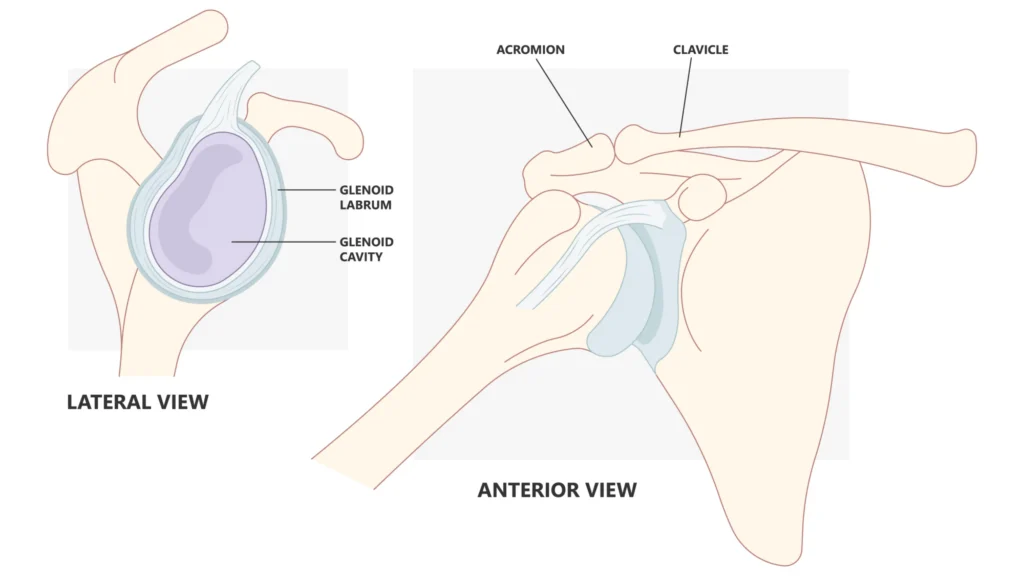
Beyond deepening the socket, the labrum serves as an anchor point for several important structures, including the biceps tendon at the top and the glenohumeral ligaments around the sides. These attachments play a direct role in shoulder stability, especially during overhead and rotational movements. When the labrum tears, that anchor system is disrupted.
How Labral Tears Happen
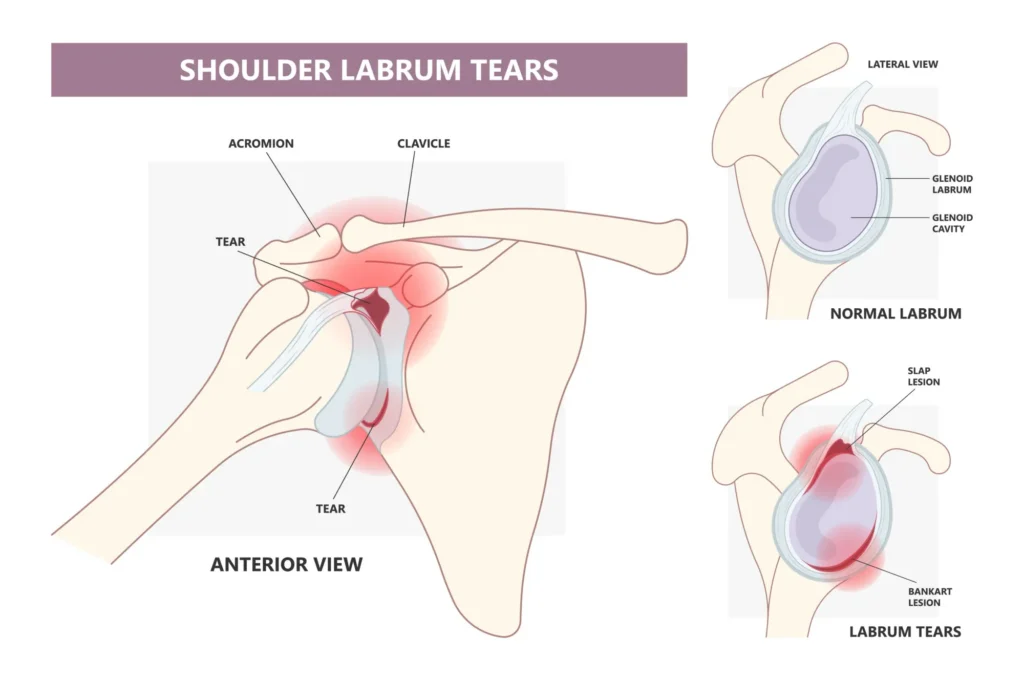
Labral tears tend to fall into two broad categories. Traumatic tears occur after a sudden, forceful event. A shoulder dislocation is one of the most common culprits, and in younger patients especially, a first-time dislocation often involves a Bankart tear of the front-lower labrum. Direct blows to the shoulder, hard falls onto an outstretched arm, and sudden pulling or wrenching injuries can all produce the same result.
The second category is overuse. Repetitive overhead motion places repeated stress on the labrum over time. Baseball pitchers, swimmers, volleyball players, and people whose jobs involve frequent lifting above shoulder height are all at higher-than-average risk. This type of wear-related injury tends to affect the top portion of the labrum, where the biceps tendon attaches, and is commonly referred to as a SLAP tear (Superior Labrum Anterior to Posterior).
Age matters too. As we get older, the labrum loses some of its resilience. Degenerative tears in older patients tend to be less dramatic in onset but can still produce significant symptoms, particularly when combined with other shoulder conditions like rotator cuff disease or arthritis.
What a Labral Tear Feels Like
One of the first things I tell patients is that labral tear pain tends to be vague and difficult to locate precisely. Unlike a rotator cuff tear, which often produces a very specific arc of pain or a clear moment of weakness, a labral injury commonly causes a deep, diffuse ache somewhere inside the shoulder that patients struggle to point to.
The most telling symptoms are mechanical in nature. Patients may describe a clicking, catching, or clunking sensation when they move the shoulder through certain ranges of motion. Some feel a sense of instability, as if the shoulder might slip out of place or simply give way under load. Pain with overhead activity, pain when reaching across the body, and discomfort when sleeping on the affected side are all common. Throwers may notice a loss of velocity or accuracy before pain even becomes the primary complaint.
Additionally, the shoulder may simply feel unreliable. Patients will describe avoiding certain positions without even thinking about it, compensating naturally until the compensation patterns start causing their own problems.
How I Diagnose a Labral Tear
Diagnosing a labral tear requires more than just imaging. I start with a thorough history. Understanding how the injury happened, how long the symptoms have been present, and exactly what movements provoke them gives me a lot of clinical information before I even examine the shoulder. In my fellowship training at the San Francisco Shoulder and Upper Extremity program, we spent considerable time on the physical examination of the unstable shoulder, and I still lean on those exam findings today.
Imaging plays an important supporting role. Standard X-rays help me evaluate bone alignment and rule out associated bony injuries. An MRI arthrogram, where contrast dye is injected into the joint before imaging, gives the best visualization of the labrum itself. Standard MRI without contrast can miss some labral tears, particularly smaller ones, so I will likely recommend the arthrogram study when clinical suspicion is high.
What I See in My Patients
In my practice, the patients who present with labral tears tend to fall into a few recognizable patterns. The most common group is active patients in their twenties and thirties who have had at least one dislocation event. They come in after a dislocation, get reduced in an emergency room, put on a sling for a few weeks, and then try to return to sports or normal activity. Some do fine. But the ones who had a significant Bankart tear with that dislocation often come later with a shoulder that keeps slipping, or that they simply no longer trust.
The second group I see frequently is overhead athletes and manual workers. These are the patients whose symptoms crept up rather than arriving all at once. A pitcher who notices his velocity dropping in the middle of a season. A roofer in the Kaufman area who has been pushing through shoulder aches for two years and finally cannot lift past 90 degrees without sharp pain. The labrum has been taking incremental damage, and by the time they reach my office, conservative care has often already been tried.
The third group is older patients, often in their fifties or sixties, with degenerative labral fraying that showed up alongside a rotator cuff problem on imaging. In those patients, I prioritize understanding which structure is actually driving their symptoms, because treating the wrong thing first is a waste of everyone’s time.
My Approach to Treatment
My default is to exhaust conservative options before recommending surgery, but I am also direct with patients when I think non-surgical treatment is unlikely to succeed. Chasing stability with physical therapy alone in a patient who has already had three dislocations is not a good use of time, in my experience.
For patients with mild to moderate symptoms, no instability, and a partial-thickness or degenerative tear, I may start with a structured physical therapy program. The goal is to strengthen the rotator cuff and periscapular muscles to compensate for the labral deficit and reduce the mechanical demands on the torn tissue. Anti-inflammatory medications can help manage pain during this period.
When surgery becomes appropriate, the procedure I perform most commonly is arthroscopic labral repair. This is a minimally invasive procedure done through small incisions around the shoulder. Using a camera and small instruments, I reattach the torn labrum back to the rim of the socket using suture anchors. The anchors are inserted into the bone at the glenoid rim, and sutures are passed through the labral tissue to pull it back into its anatomic position and hold it while healing occurs.
In cases where bone loss is significant at the glenoid, a soft tissue repair alone may not be sufficient, and a bony augmentation procedure may be necessary to provide adequate stability. I discuss those cases individually with patients and walk through the reasoning before we make any decisions.
What to Expect During Recovery
Recovery from arthroscopic labral repair requires patience. The labrum heals slowly because cartilage tissue does not have the same blood supply as muscle or bone. I generally keep patients in a sling for about four weeks after surgery. During that period, the shoulder is protected while early healing occurs. Passive range-of-motion exercises start right away, helping prevent stiffness without stressing the repair.
Active motion typically begins around six weeks. Strengthening usually starts around three months. Return to most daily activities is possible within three to four months for many patients. Return to overhead sports or heavy physical labor generally takes closer to five to six months, and some throwing athletes may need nine to twelve months to return to full competitive activity. The timeline varies with the size and location of the tear, the patient’s baseline strength, and how consistently they follow through with physical therapy.
I am direct about this with my patients in Sunnyvale and Kaufman: the rehab is not optional. I can repair the labrum arthroscopically, but the shoulder may not regain full strength or stability without a committed effort in physical therapy.
Summary
A labral tear in the shoulder is a meaningful injury. It can produce instability, pain with activity, and a loss of confidence in the joint that affects everything from sports to daily chores. The good news is that most patients have real treatment options available, both non-surgical and surgical, and most do well with the right approach.
If you have been dealing with shoulder pain that involves clicking, catching, or a sense that the joint is unreliable, that is worth getting evaluated. The earlier we identify a labral tear and address it appropriately, the better the chance of protecting the rest of the shoulder from downstream problems. If you are in the Sunnyvale or Kaufman area, I encourage you to schedule a consultation so we can get an accurate picture of what is going on and put together a plan that fits your lifestyle.
Frequently Asked Questions
Can a labral tear in the shoulder heal on its own?
Some minor or partial labral tears may improve with rest, activity modification, and physical therapy. However, complete tears, tears associated with instability, or tears in patients who continue to experience dislocations are unlikely to heal without surgical intervention. Whether non-surgical treatment is a reasonable option depends on the tear’s location, severity, and the patient’s activity goals.
Will I need surgery for a labral tear?
Not necessarily. Many patients manage well with conservative care, especially if the tear is partial, not associated with instability, and the shoulder remains functional. Surgery is typically recommended when symptoms persist despite months of appropriate non-surgical treatment, when significant instability is present, or when the tear is severe enough that conservative care is unlikely to restore adequate function.
What is the difference between a Bankart tear and a SLAP tear?
Both are labral tears, but they occur in different locations. A Bankart tear involves the front and lower portion of the labrum and is typically caused by a shoulder dislocation. A SLAP tear involves the superior labrum, or the top of the socket, near where the biceps tendon attaches. SLAP tears are more commonly seen in overhead athletes and workers who perform repetitive lifting or throwing motions.