Medically reviewed by Jeff Zhao, DO | Reviewed June 2026
If you follow baseball, or really any throwing sport, you’ve likely heard the term Tommy John surgery. Most people know it as the surgery that sidelined a favorite pitcher for a year. What fewer people understand is what the procedure involves, why the ulnar collateral ligament tears in the first place, and, most importantly, whether they or someone they care about might need it. In my practice at Dallas Orthopedic & Shoulder Institute, I see elbow injuries across all ages and activity levels, from competitive athletes in the East Dallas area to weekend warriors who haven’t slowed down. Tommy John surgery is a procedure I perform, and I want patients to walk in knowing what to expect.
Key Takeaways
- Tommy John surgery reconstructs the ulnar collateral ligament (UCL) on the inner side of the elbow using a tendon graft.
- The UCL is most commonly injured through repetitive overhead throwing, though acute tears can happen too.
- Not every UCL injury requires surgery. I start with conservative care for many patients, and some do very well without an operation.
- Recovery typically spans 12 to 18 months for athletes returning to overhead throwing sports.
What Is Tommy John Surgery?
Tommy John surgery is the common name for ulnar collateral ligament (UCL) reconstruction. The UCL is a thick band of tissue on the inner side of the elbow. It connects the humerus (upper arm bone) to the ulna (one of the forearm bones) and plays a central role in stabilizing the elbow during throwing motions. When this ligament tears or becomes severely stretched, it can no longer do its job.
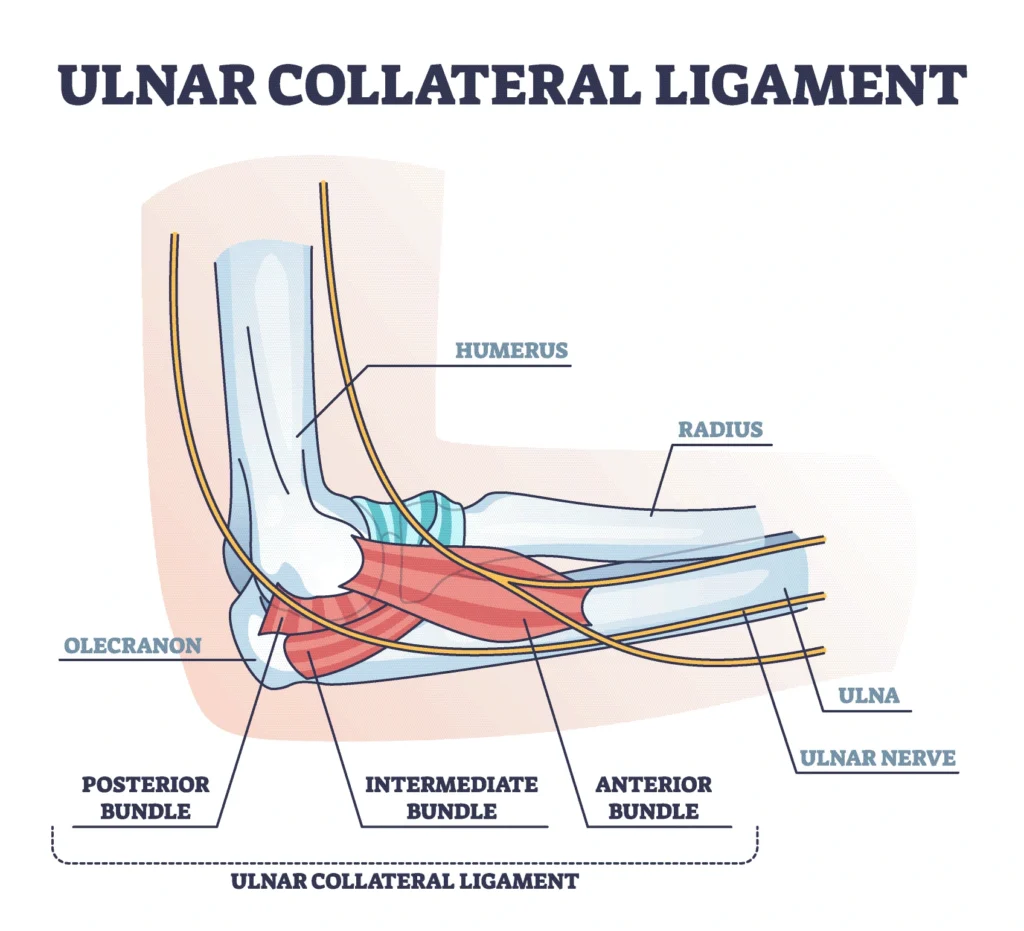
The procedure takes a tendon graft, most often from the patient’s own forearm (palmaris longus tendon) or occasionally from a donor source, and weaves it through small tunnels drilled in the humerus and ulna. Over time, that graft heals and essentially becomes the new UCL. The surgery gets its name from Tommy John, the MLB pitcher who was the first to undergo the procedure back in 1974.
One thing I tell patients right away: this is a reconstructive surgery, not a repair. We aren’t sewing the torn ligament back together. We’re replacing it. That distinction matters because it explains why the recovery timeline is long.
What Causes a UCL Tear?
The ulnar collateral ligament takes an enormous amount of stress during overhead throwing. At the point of maximum external rotation in a pitch, the forces on the inner elbow can approach or exceed the structural limits of the ligament. Baseball pitchers are the most commonly discussed group, but UCL injuries also affect football quarterbacks, javelin throwers, tennis players, gymnasts, and even volleyball players.
Tears can happen in two main ways. A single, forceful throw can cause an acute tear, and you’ll probably know it immediately. There is often a sudden pop on the inner elbow followed by sharp pain and loss of velocity or control. More often, though, the UCL wears down gradually. Tiny micro-tears accumulate over months or years of high-volume throwing. The ligament weakens before it fully fails. This is the pattern I see most often in competitive youth and collegiate athletes, and it’s one reason that pitch count guidelines and proper rest matter.
Age and sport specialization have pushed UCL reconstruction rates up significantly in recent decades. We are seeing this surgery in younger patients than ever before. That trend concerns me, and I always try to ask about training volume when I evaluate a young thrower with elbow pain.
Symptoms That Bring Patients to My Office
The presenting picture varies depending on whether the tear was sudden or developed over time. Inner elbow pain is the most consistent finding, and it typically worsens with throwing or other overhead activity. Many patients describe a sense of looseness or instability in the elbow, as though the joint shifts when they load it.
Loss of velocity and control are common early signs that athletes notice before the pain becomes obvious. Pitchers may find their fastball dropping several miles per hour, or that they’re suddenly wild in ways they weren’t before. If the ulnar nerve is irritated alongside the UCL, tingling or numbness can travel into the ring and little fingers, a pattern that overlaps with cubital tunnel syndrome.
Some patients in the Sunnyvale and Kaufman areas come to me having already pushed through symptoms for months. They taped it, rested it for a few weeks, and came back too early. By the time I see them, the ligament has had little chance to recover. If you’re a thrower experiencing inner elbow pain that has not resolved with two to three weeks of rest, I’d rather evaluate you sooner than later.
How I Diagnose a UCL Injury
Diagnosis starts with a detailed conversation about your throwing history, training volume, when the pain started, and what makes it better or worse. Then I examine the elbow directly. The valgus stress test and the moving valgus stress test are my go-to clinical maneuvers. When I apply a controlled inward force on the elbow at different angles of flexion and reproduce your pain, that tells me a lot about the UCL’s integrity.
Imaging confirms what the exam suggests. Standard X-rays can reveal bone spurs or loose bodies, which are common in overhead athletes. MRI with or without contrast (arthrogram) provides the clearest picture of the ligament itself, allowing me to assess the degree of tearing and whether any structures nearby are involved. I make the final call on surgical candidacy based on the full picture, not just the MRI alone.
What I See in My Patients
I’ve been doing elbow surgery in the East Dallas area for well over a decade, and the range of patients I evaluate for UCL injuries is wider than most people expect. Yes, I see competitive pitchers. But I also see a 40-year-old recreational softball player who threw too hard on opening day, a high school quarterback who played through pain all season, and a college tennis player whose serve fell apart before her shoulder did.
The most consistent thing I see in patients who end up needing surgery is a history of pushing through symptoms. The elbow gives you signals early. Medial elbow soreness that lingers after a game, inconsistent control, or that slight pop that didn’t seem like a big deal at the time; these are the early warnings I wish more athletes acted on. A UCL that’s strained but not completely torn can often be managed without surgery. A UCL that’s been loaded through a full season of pain frequently cannot.
I also see a lot of patients who arrive convinced they need Tommy John surgery when they don’t. Medial elbow pain has more than one cause. Medial epicondylitis, also known as golfer’s elbow, can produce nearly identical symptoms. So can ulnar nerve irritation. Getting the diagnosis right before committing to a 12-to-18-month recovery is something I feel strongly about.
My Approach to Treatment
I do not rush patients to the operating room. My first step with any UCL injury is to see whether conservative management can get the patient back to where they want to be. For partial tears or injuries in non-throwing athletes, rest, activity modification, and a structured physical therapy program can deliver real results. We unload the elbow, address any mechanical issues in the shoulder or core that may be contributing, and give the tissue a genuine chance to heal. Some patients do very well with this approach and never need surgery.
When surgery is the right answer, I perform UCL reconstruction using a technique that preserves the flexor-pronator muscle group as much as possible. The goal is to restore stability without creating unnecessary trauma to the surrounding tissue. I also address any concomitant pathology, like loose bodies or ulnar nerve irritation, at the same time.
My fellowship training at the San Francisco Shoulder & Upper Extremity program under Dr. Tom Norris gave me a strong foundation in complex upper extremity reconstruction, and Tommy John surgery sits squarely in that category. I approach every case individually. The graft choice, the tunnel position, the nerve management; these decisions are made based on what I find in the operating room, not a one-size-fits-all protocol.
Recovery: What the Timeline Actually Looks Like
I tell every patient who undergoes Tommy John surgery that recovery is a job. A twelve-to-eighteen-month job. The graft needs time to incorporate, and the elbow needs time to regain its strength and coordination before it can absorb throwing stress.
The early weeks focus on protecting the graft and managing swelling. Physical therapy begins relatively soon after surgery, starting with gentle range-of-motion work. Strengthening of the forearm, wrist, and shoulder progresses as the graft matures. For throwing athletes, a structured return-to-throw program typically starts around the four-to-six-month mark, building from light tossing to full velocity over several additional months.
Pitchers returning to competitive baseball generally need closer to 14 to 18 months before they are cleared to pitch at full intensity. Position players may return sooner. Non-throwing patients with active but non-throwing lifestyles often have a shorter timeline. I set these expectations clearly from day one.
The patients who come back strongest are the ones who treat every phase of rehab as seriously as they treated their sport. It’s what the evidence supports, and it’s what I see in my own results.
Summary
Tommy John surgery is a well-established procedure with a strong track record when performed on the right patient for the right reasons. If you’re an athlete dealing with inner elbow pain that hasn’t responded to rest, or if you’ve been told you might have a UCL injury and you’re not sure what to do next, my recommendation is straightforward: come in and get evaluated. Not every UCL injury needs surgery, but each deserves a proper diagnosis. You can reach my office in Sunnyvale or Kaufman, Texas by calling (972) 635-8741 or scheduling online.
Frequently Asked Questions
Does Tommy John surgery make pitchers throw faster?
This is a common belief and it deserves a direct answer: not really. What the surgery does is restore stability. Some pitchers do return throwing faster than before, but that’s likely because the UCL was compromised before surgery and the athlete was compensating. The graft itself does not add velocity. What you get back is the ability to throw without pain and with a stable elbow.
What happens if I don’t have surgery on a torn UCL?
That depends heavily on your goals and the degree of tearing. A non-thrower with a UCL tear may function very well without surgery. A competitive pitcher with a complete UCL tear will almost certainly not return to full throwing without reconstruction. Untreated instability can also stress the surrounding structures over time, potentially causing additional problems. This is exactly why I evaluate each case individually rather than applying a blanket recommendation.
Does elbow pain always mean a UCL problem?
Not at all. Medial elbow pain has several possible sources, including golfer’s elbow, ulnar nerve irritation, and elbow arthritis. Getting the right diagnosis is the most important first step.