

Medically reviewed by Jeff Zhao, DO | Reviewed May 2026
If you’ve been dealing with elbow pain, you may have heard the terms golfer’s elbow and tennis elbow. I see both of these regularly in my practice, and patients often come in unsure which one they have. Golfer’s elbow vs. tennis elbow refers to two distinct conditions that affect different parts of the elbow, involve different tendons, and may require different approaches to treatment. Understanding the difference can help you have a more informed conversation with your doctor and get the right care for your specific situation.
Key Takeaways
- Tennis elbow affects the outer side of the elbow; golfer’s elbow affects the inner side.
- Most patients may improve with conservative treatment, including rest, physical therapy, and bracing.
- Surgery may be considered for cases that haven’t improved after a thorough course of conservative management.
What Are These Conditions, Really?
Both golfer’s elbow and tennis elbow fall into the category of epicondylitis, conditions involving tendon degeneration and irritation near the bony prominences on either side of the elbow. The medical names are lateral epicondylitis for tennis elbow and medial epicondylitis for golfer’s elbow. “Lateral” refers to the outer side; “medial” refers to the inner side.
Despite their sporty names, you don’t have to be an athlete to develop either condition. I regularly see these injuries in people who work in construction, IT, food service, and all kinds of other professions. Any activity that involves repetitive gripping, wrist movement, or forearm rotation can put stress on these tendons over time.
Tennis Elbow (Lateral Epicondylitis): The Outer Side
Tennis elbow develops when the tendons attaching to the lateral epicondyle, the bony bump on the outside of your elbow, become irritated or damaged. These tendons connect the forearm muscles responsible for extending your wrist and fingers. When those muscles are overworked repeatedly, small tears and degenerative changes can develop in the tendon tissue, leading to pain and tenderness.
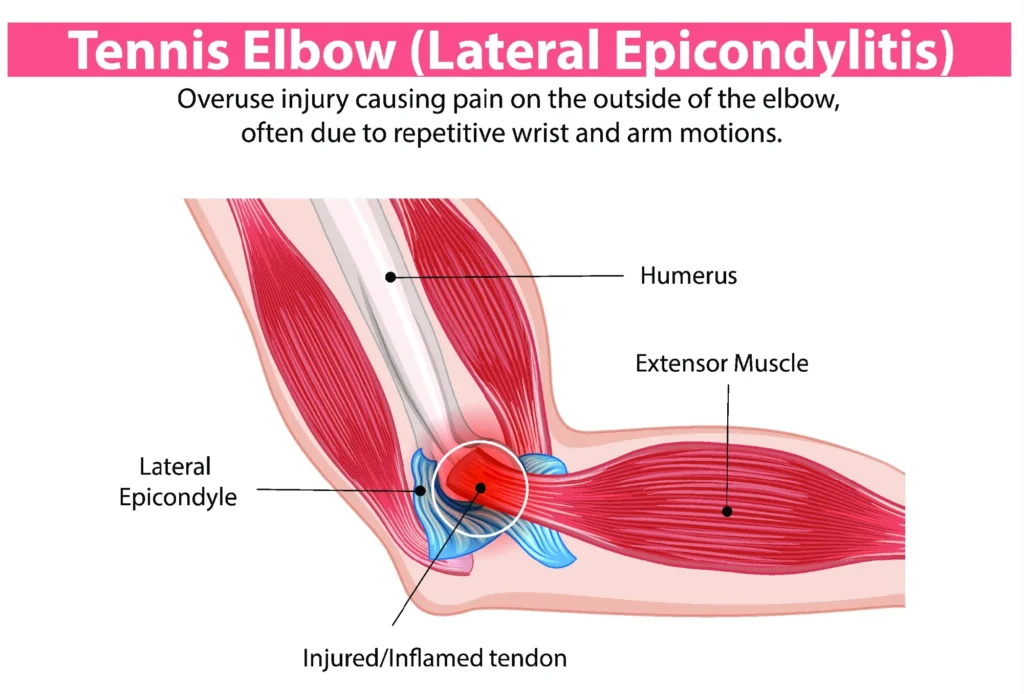
The symptoms tend to show up in ways that affect daily life more than people expect. The three I hear about most often are:
- Pain and tenderness on the outer elbow, especially at that bony bump
- Discomfort that worsens with gripping or twisting motions, like turning a doorknob or opening a jar
- Pain that may radiate down the forearm toward the wrist
Grip weakness is also common, and it tends to be the symptom that finally motivates patients to come in. Many patients tell me they’ve been pushing through the pain for months before the grip issues made everyday tasks genuinely frustrating.
Interestingly, tennis actually accounts for only a minority of cases. Painters, carpenters, plumbers, cooks, and computer users are among the many groups who commonly develop lateral epicondylitis. The common thread is repetitive forearm activity, not necessarily a racket in your hand.
Golfer’s Elbow (Medial Epicondylitis): The Inner Side
Golfer’s elbow involves the tendons on the medial epicondyle, the bony bump on the inside of the elbow. These tendons connect the muscles that flex your wrist and fingers. When repetitive gripping or wrist-flexion activities place ongoing stress on the tendon tissue, degenerative changes associated with golfer’s elbow can develop over time.
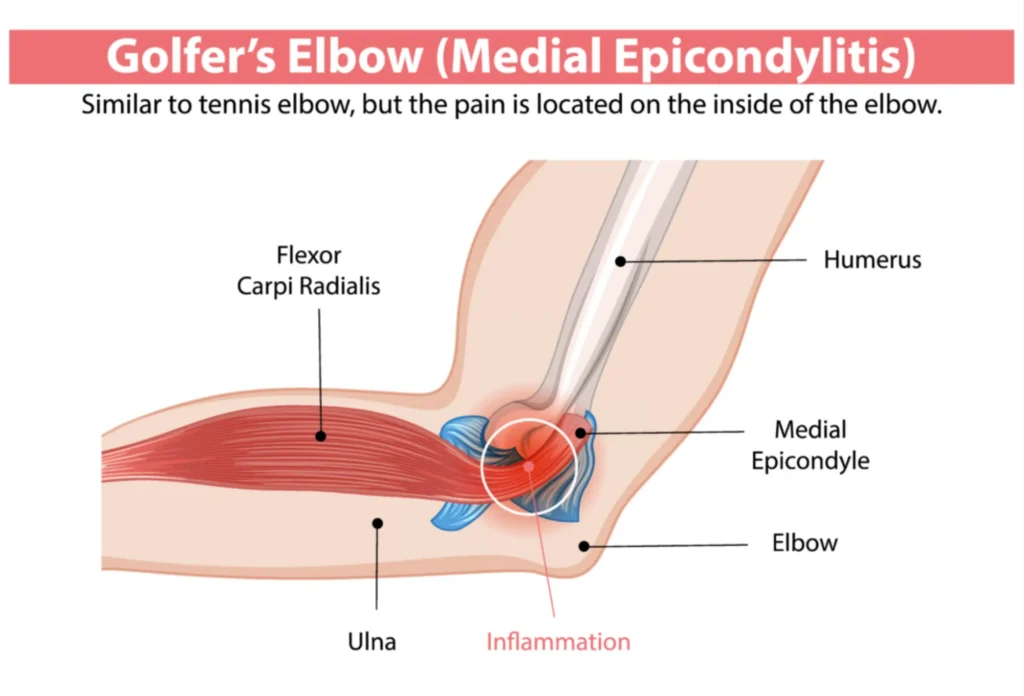
The pain from golfer’s elbow tends to show up on the inner elbow and may spread toward the forearm. Symptoms may include:
- Pain and tenderness concentrated on the inner elbow
- Tingling or numbness that may radiate into the ring and little fingers
- Pain that worsens with wrist flexion, throwing motions, or using hand tools
Grip weakness and morning stiffness that loosens up as the day goes on are also common. Many of my patients describe both.
The tingling sensation that sometimes accompanies golfer’s elbow can be a source of confusion. It may feel similar to nerve-related symptoms, and in some cases, the ulnar nerve, which runs along the inner elbow, may be involved.
Who Gets These Conditions?
Age is a factor for both conditions. Both tend to be most common in people between 30 and 50, though they can certainly affect younger and older individuals as well. In my Sunnyvale and Kaufman, Texas practices, repetitive occupational activities account for a large share of the cases I see.
For tennis elbow, common culprits include racket sports (particularly with poor technique or an ill-fitted grip), painting, plumbing, carpentry, and repetitive typing. For golfer’s elbow, throwing sports, golf, rock climbing, weightlifting, and jobs requiring repeated use of hand tools are frequently associated with the condition.
A sudden forceful movement can sometimes trigger symptoms, but more often these conditions develop gradually. Patients typically notice that the discomfort builds over weeks or months before it becomes severe enough to seek care. By the time many people come to see me, they’ve been managing the pain on their own for quite a while.
How We Diagnose Elbow Pain
Diagnosis typically starts with a conversation about your symptoms and activities, followed by a hands-on physical examination. I’ll check where the tenderness is located, assess your grip strength, and perform specific movement tests designed to reproduce the discomfort and help pinpoint which tendons are involved.
Imaging may be helpful in some cases. An X-ray won’t show tendon damage directly, but it can rule out other causes of elbow pain like arthritis or bone spurs. An ultrasound or MRI may be used in some cases to assess the degree of tendon involvement and guide treatment decisions, particularly if we’re evaluating whether a minimally invasive procedure might be appropriate.
Accurate diagnosis matters. There are other common elbow conditions that can produce symptoms overlapping with those of epicondylitis. A thorough evaluation helps ensure we’re treating the right problem.
Treatment Options: Starting Conservative
For most patients, I start with non-surgical approaches. My experience is that many people with either condition can find meaningful relief with consistent conservative care. Rest and activity modification are usually the first steps. That doesn’t necessarily mean complete immobilization, but it does mean temporarily reducing or avoiding the activities that aggravate the tendons. This allows the tissue some space to begin healing.
Physical therapy plays a role in recovery. Eccentric strengthening exercises, where the muscle lengthens while under tension, are commonly incorporated into rehabilitation programs for both conditions. Your therapist may also work on flexibility, shoulder and forearm mechanics, and manual techniques to reduce pain and restore function.
Additionally, a counterforce brace worn just below the elbow may help reduce stress on the irritated tendon during activity. Anti-inflammatory medications may also be recommended to manage pain in the short term.
The Tenex Procedure: A Minimally Invasive Option
When conservative treatment hasn’t provided adequate relief, I may offer the Tenex procedure, a minimally invasive technique for both lateral epicondylitis and medial epicondylitis. The procedure uses ultrasound guidance to precisely locate the damaged tendon tissue. A specialized device then removes that degenerated tissue through a small incision.
The Tenex procedure takes approximately 15 minutes and is performed under local anesthesia. Patients are discharged the same day. Because it targets only the damaged tissue while leaving healthy tendon intact, the disruption to surrounding structures is minimal. This option tends to be a good fit for patients whose symptoms have persisted despite several months of dedicated conservative treatment and who want to avoid traditional open surgery. Not every patient will be a candidate, but for the right individual, it can be a meaningful option.
When Surgery May Be Recommended
I typically discuss surgical options when a patient has gone through months of appropriate conservative management without adequate improvement, and when symptoms are significantly interfering with daily life or work. Surgical treatment for epicondylitis typically involves releasing or debriding the damaged tendon tissue. As with any surgical intervention, it carries its own considerations, which I discuss thoroughly with each patient before any decisions are made.
Prevention: Reducing Your Risk
You can’t always prevent these conditions entirely, but there are steps that may reduce the risk. Warming up before physical activity, using proper technique during sports or work tasks, and avoiding sudden increases in activity intensity can all help protect your tendons. Strengthening the forearm muscles through a balanced exercise routine may also build some resilience over time.
For tennis players, racket grip size and string tension can matter more than you might expect. For those who work in physically demanding roles, ergonomic adjustments and regular breaks may help reduce cumulative stress. If you notice mild elbow pain starting to develop, seeking evaluation early rather than continuing aggravating activities may help reduce further tendon irritation.
Summary
Golfer’s elbow vs. tennis elbow may share some similarities on the surface, but they’re distinct conditions with different locations, different tendons involved, and sometimes different symptom profiles. Tennis elbow (lateral epicondylitis) affects the outer elbow and tends to cause pain with gripping and wrist extension. Golfer’s elbow (medial epicondylitis) affects the inner elbow and tends to cause pain with wrist flexion.
Both conditions are treatable. Many patients experience improvement with rest, physical therapy, bracing, and other conservative measures. For those who need more, the Tenex procedure offers a minimally invasive path forward, and surgery may be an option for the most persistent cases. If elbow pain has been slowing you down, I’d encourage you to come in for an evaluation. The sooner we understand what’s going on, the more options we typically have.
Frequently Asked Questions
Can I have both golfer’s elbow and tennis elbow at the same time?
It’s uncommon, but yes, it is possible to develop both conditions simultaneously. This tends to occur in individuals who perform heavy, repetitive physical work that stresses both sides of the elbow. If you’re experiencing pain on both the inner and outer elbow, a thorough evaluation can help clarify what’s happening and guide a treatment approach.
Do I have to stop playing sports to recover?
Not necessarily. Activity modification, rather than complete rest, is often the approach we start with. In many cases, we can work around your activity level rather than eliminating it entirely. The goal is to reduce stress on the affected tendons while still keeping you as active as possible. Your specific situation and symptom severity will guide what’s appropriate.
How do I know if my elbow pain is tennis elbow, golfer’s elbow, or something else?
The location of your pain is an important clue. Outer elbow pain suggests lateral epicondylitis (tennis elbow), while inner elbow pain points toward medial epicondylitis (golfer’s elbow). However, other conditions like cubital tunnel syndrome, elbow arthritis, or even referred neck pain can produce overlapping symptoms. The most reliable way to get a clear answer is through a clinical evaluation.