

Medically reviewed by Jeff Zhao, DO | Reviewed May 2026
If you’ve ever woken up with a numb ring finger and pinky, noticed your grip feels weaker than it used to, or found that talking on the phone for a while makes your hand feel strange and clumsy, you may be dealing with cubital tunnel syndrome. But what is cubital tunnel syndrome and how is it treated?
I treat this condition regularly in my Sunnyvale and Kaufman, Texas practices, and I want patients to know that it responds well when we catch it early. In this post, I’ll cover what cubital tunnel syndrome is, what causes it, how we diagnose it, and what we can do together to get you feeling like yourself again.
Key Takeaways
- Cubital tunnel syndrome develops when the ulnar nerve is compressed at the inner elbow, causing numbness, tingling, and weakness in the ring and little fingers.
- Symptoms may worsen when the elbow is held in a bent position for extended periods, such as during sleep or while using a phone.
- Conservative treatments, including activity modification, nighttime splinting, and nerve gliding exercises, can help manage mild to moderate cases effectively.
- When non-surgical approaches aren’t enough, endoscopic cubital tunnel release is a minimally invasive surgical option.
Understanding the Ulnar Nerve
Your elbow is more than a simple hinge. It’s a complex joint housing several important nerves, blood vessels, and tendons, all working together to give you the strength and coordination you rely on every day. One of the key players in this system is the ulnar nerve.
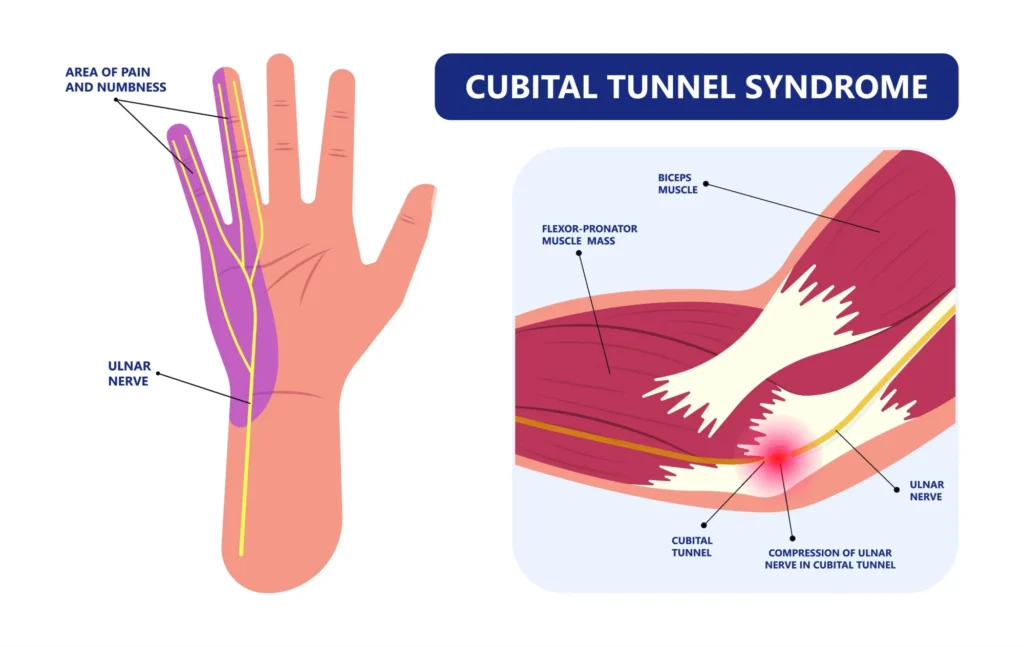
The ulnar nerve travels from your neck all the way down your arm, looping behind the inner side of your elbow through a passageway called the cubital tunnel. You’ve almost certainly felt this nerve before without realizing it. That sharp, electric jolt when you bump your elbow just right? That’s the ulnar nerve, which people have long called the “funny bone.”
The ulnar nerve controls sensation in your ring and little fingers and plays a major role in hand strength, coordination, and the precise finger movements you need for everyday tasks. When this nerve gets compressed, stretched, or irritated at the elbow, the result is cubital tunnel syndrome.
What Causes Cubital Tunnel Syndrome?
There isn’t always one clear-cut reason why the ulnar nerve becomes compressed. Several factors may contribute, and sometimes they work together over time.
One of the most common contributors is prolonged elbow flexion. When you keep your elbow bent for long stretches (talking on the phone, sleeping with your arm curled under a pillow, or resting your chin on your hand), the pressure on the ulnar nerve within the cubital tunnel may increase. Doing this repeatedly, night after night, may irritate the nerve over time.
Direct pressure on the inner elbow is another common factor. Leaning your elbow on a hard armrest or desk edge for extended periods can compress the nerve from the outside. People who spend many hours at a desk are particularly susceptible to this.
Anatomical factors can also play a role. In some patients, the ulnar nerve doesn’t sit quietly in its groove; it slides back and forth over the bony prominence on the inner elbow with repeated motion, causing friction and gradual irritation. Previous elbow injuries, bone spurs, or swelling from arthritis may narrow the tunnel and squeeze the nerve as well.
And for some patients, there’s no dramatic cause at all. The nerve simply becomes sensitive over time, particularly in those who use their arms repetitively at work or in sports.
Recognizing the Symptoms
The three I hear about most consistently from my patients are:
- Numbness and tingling in the ring and little fingers, especially when the elbow is bent or after prolonged pressure on the inner elbow
- Aching or pain at the inner elbow, which may radiate down the forearm toward the hand
- Symptoms that worsen at night or when holding a phone to your ear for an extended period
Grip weakness and clumsiness with fine motor tasks like buttoning a shirt or typing are also common. Patients often describe these as the most frustrating part because they affect everyday life in very direct ways.
In milder cases, the numbness or tingling may come and go. As cubital tunnel syndrome progresses, those sensations can become more constant. Weakness in the hand or visible muscle wasting between the fingers may point toward more advanced nerve compression.
How We Diagnose Cubital Tunnel Syndrome
When a patient comes in with these kinds of symptoms, I start with a thorough examination. I’ll ask about your daily habits, your work setup, how long the symptoms have been present, and what makes them better or worse. During the exam, I’ll check for tenderness over the cubital tunnel at the inner elbow and assess your grip strength and sensation. Imaging can also be helpful. X-rays may reveal bone spurs or joint changes that might be narrowing the tunnel. In some cases, I may recommend a nerve conduction study.
Treatment Options: Starting with Conservative Care
When we catch cubital tunnel syndrome early, non-surgical treatment tends to work quite well. Activity modification is typically the first step. This means identifying which positions and movements aggravate the nerve and making adjustments where possible. Something as simple as adding a cushioned elbow pad at your desk or switching your phone to the other hand during calls may reduce your daily nerve irritation.
When we sleep, many of us unconsciously curl our elbows up tight, which puts the ulnar nerve in a stretched position for hours at a stretch. Wearing a soft splint that keeps the elbow at a more neutral angle during sleep may help reduce symptoms over time.
Nerve gliding exercises may be part of the rehabilitation process as well. These gentle movements encourage the nerve to slide smoothly through its pathway rather than becoming restricted or stuck.
Anti-inflammatory medications may help manage discomfort and reduce swelling. These are often part of a broader conservative plan, though they work best in combination with the other approaches rather than as a standalone solution.
When Surgery Becomes the Right Option
If conservative treatment doesn’t provide adequate relief after a reasonable trial period, or if the nerve compression is already causing notable weakness or muscle changes, surgery may be the right next step. The surgical procedure I often recommend for cubital tunnel syndrome is endoscopic cubital tunnel release. This minimally invasive technique uses a small camera and specialized instruments to visualize the ulnar nerve and release the tight tissue that’s compressing it. An experienced elbow specialist will take the time to walk you through the options and help you understand which approach makes the most sense for your specific situation.
What Happens If Cubital Tunnel Syndrome Is Left Untreated?
Mild cases of cubital tunnel syndrome may plateau or even improve with consistent lifestyle changes. But when nerve compression goes unaddressed for an extended period, the nerve can sustain more lasting damage.
Advanced, untreated cubital tunnel syndrome may lead to permanent weakness or visible muscle wasting in the hand, particularly between the fingers and in the palm. Tasks that depend on precise finger coordination, such as typing, playing an instrument, or using tools, can become increasingly difficult. Recovery can become more challenging once significant nerve damage has occurred. That’s why I encourage patients who are experiencing these symptoms to come in for an evaluation rather than waiting to see if things improve on their own.
Summary
Cubital tunnel syndrome is a nerve compression condition caused by pressure or irritation to the ulnar nerve at the inner elbow. The usual symptoms (numbness and tingling in the ring and little fingers, hand weakness, and inner elbow discomfort that worsens with prolonged bending) may develop gradually and worsen over time if left unaddressed. Conservative treatments like activity modification, nighttime splinting, nerve gliding exercises, and anti-inflammatory medications tend to work well when the condition is identified early. When those approaches aren’t enough, endoscopic cubital tunnel release offers a minimally invasive path. If any of these symptoms sound familiar, I’d encourage you to schedule an evaluation.
Frequently Asked Questions
Is cubital tunnel syndrome the same as carpal tunnel syndrome?
They’re related in the sense that both involve nerve compression in the arm, but they affect different nerves at different locations. Carpal tunnel syndrome involves the median nerve at the wrist. Cubital tunnel syndrome involves the ulnar nerve at the elbow.
How do I know if I need surgery for cubital tunnel syndrome?
Surgery tends to be considered when conservative treatment hasn’t provided enough relief after a reasonable trial period, when nerve conduction studies suggest compromise, or when hand weakness and muscle changes are already present. I’ll always walk you through all of your options so you can make a fully informed decision about your care.
What should I expect after endoscopic cubital tunnel release?
Recovery varies from patient to patient, but the procedure is generally well-tolerated. Many patients can return to desk work within one to two weeks. Functional activity is often possible within two to three months. The nerve itself, however, may take longer to fully recover.