

Medically reviewed by Jeff Zhao, DO
Once patients decide to go ahead with surgery, the next question I hear is almost always, “How long until I can use my hand again?” Carpal tunnel surgery recovery happens in stages, and most people are using their hand for light tasks much sooner than they expect. Full strength, on the other hand, takes patience. I perform both endoscopic and open carpal tunnel release for patients in Sunnyvale, Kaufman, and the communities east of Dallas. In this post, I break down what the first few months typically look like, week by week, so you can plan for work, driving, and daily life with realistic expectations.
Key Takeaways
- Finger movement starts right after surgery, and many patients return to light activities within a few days.
- Soreness in the palm, sometimes called pillar pain, is common and may linger for several weeks to a few months.
- Grip and pinch strength usually return around two to three months after surgery, though severe, long-standing nerve compression may take longer.
A Quick Look at the Surgery Itself
Carpal tunnel release relieves pressure on the median nerve by dividing the transverse carpal ligament, the tight band that forms the roof of the carpal tunnel. Once that ligament is released, the tunnel has more room, and pressure on the nerve is typically relieved.
I offer two approaches. Endoscopic carpal tunnel release uses a small camera and specialized instruments through a small incision, which can mean less disruption to the palm and less palm scarring.
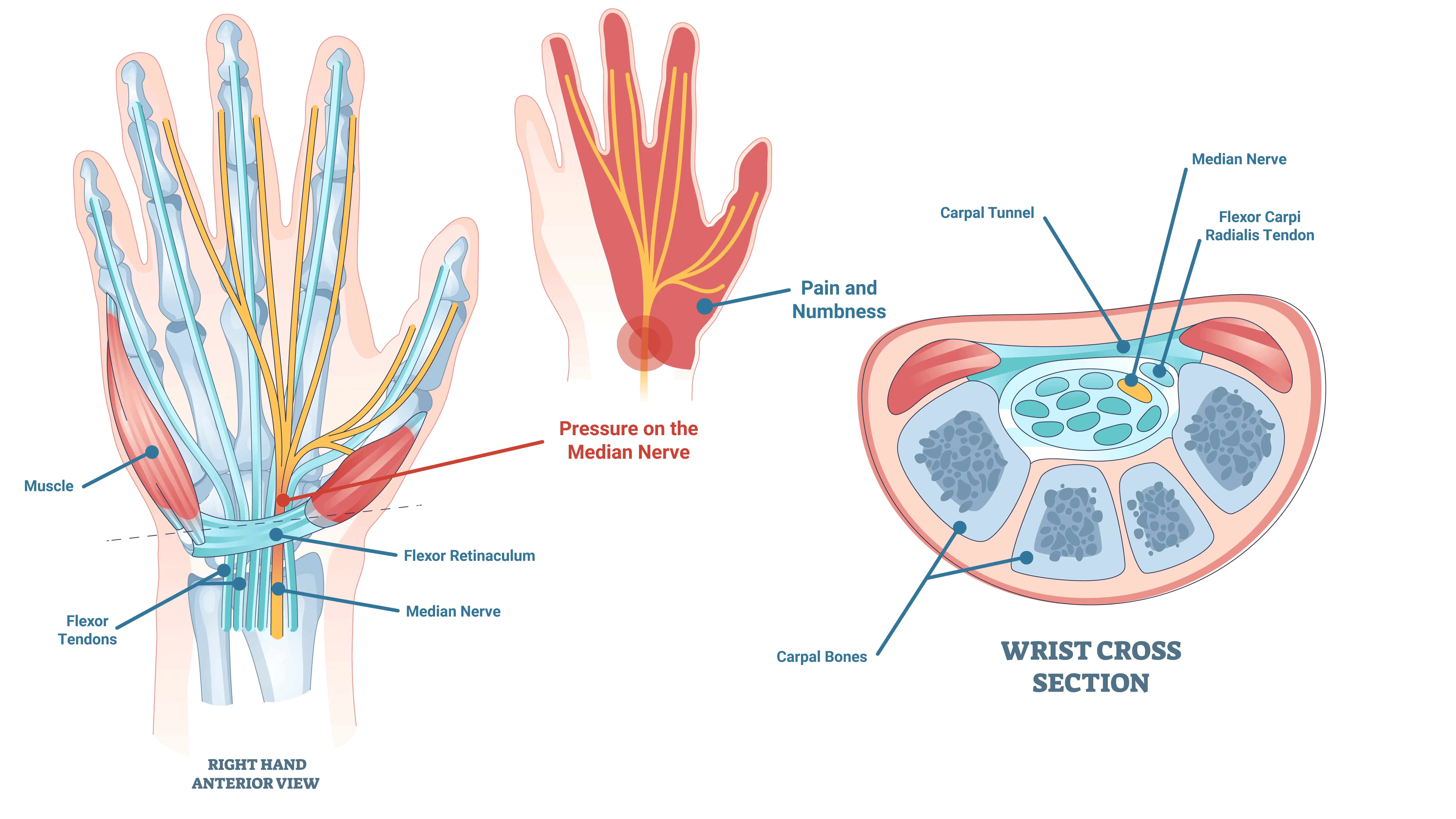
Open carpal tunnel release uses a small incision in the palm so I can see the ligament and surrounding structures directly. Both are outpatient procedures performed under local anesthesia with sedation or regional anesthesia, so most patients go home the same day.
Which approach I recommend depends on your anatomy, the severity of your symptoms, and whether there are other issues in the wrist that I need to see. The recovery milestones below apply to both, although some patients who have the endoscopic version may reach the early milestones a little sooner.
Day of Surgery and the First 48 Hours
You will leave the surgery center with a soft, bulky dressing on your hand. Your fingers will be free, and I want you to use them. Gentle finger movement, like making a loose fist and then straightening the fingers fully, can help reduce swelling and prevent stiffness.
For the first two days, the main priorities are:
- Keeping your hand elevated above the level of your heart as much as possible
- Moving your fingers several times an hour while awake
- Keeping the dressing clean and dry
The numbing medicine may last several hours. Once it wears off, the palm is usually sore. Many patients find that over-the-counter acetaminophen or anti-inflammatory medication is enough, and I discuss pain control with each patient before surgery based on their health history.
Week 1: Light Use and Managing Swelling
During the first week, most patients can begin using the hand for light daily tasks. Eating, getting dressed, brushing your teeth, and light typing are generally fine. The rule I give my patients is simple: if it is lighter than a coffee cup and does not hurt, you can probably do it.
What you should avoid this week is heavy gripping, lifting, pushing, and pulling. That includes pushing yourself up from a chair with your palm. Many people also notice their nighttime numbness and tingling ease quickly after the nerve is released, sometimes within the first few nights, although numbness that has been present for a long time usually takes longer to improve.
Driving is a common question. I generally ask patients to wait until they are no longer taking prescription pain medication and can grip the steering wheel firmly and comfortably. I would rather you wait an extra few days than drive with a hand you cannot fully control.
Week 2: Stitches Out and Getting Back to Work
If you have stitches, they are commonly removed around 10 to 14 days after surgery. Once the incision is closed and I have checked it, most patients can get the hand wet in the shower. I still recommend avoiding soaking the hand in a bath, pool, or hot tub until the incision has fully healed.
Many patients with desk jobs return to work around this point, sometimes sooner. Typing and mouse use are usually tolerated, though you may find you need short breaks. If your job involves repetitive gripping, lifting, or tools, your return to full duty will likely take longer.
Weeks 3 to 6: Pillar Pain and Building Tolerance
Weeks three through six can be the most frustrating stretch of carpal tunnel surgery recovery. The incision looks healed and the nighttime symptoms have usually improved, yet the palm may still ache when you lean on it or grip something firmly.
That ache is often pillar pain, a deep soreness at the base of the palm on either side of the incision. It is one of the most common complaints after carpal tunnel release, and it tends to fade gradually over several weeks to a few months. It does not usually mean something went wrong.
During this stage, I typically allow patients to gradually increase their activity. Light lifting, household chores, and most daily activities often become more comfortable. Some patients benefit from hand therapy for stiffness, scar sensitivity, or strengthening, while many do well with a home exercise program alone.
Weeks 6 to 12: Strength Returns
By six weeks, many patients are back to most of their normal activities, including heavier household work and many hobbies. Grip and pinch strength typically continue to improve, and they usually return by around two to three months after surgery.
People with physically demanding jobs, such as construction, mechanics, or ranch work, may need closer to this full window before they feel ready for heavy tasks. I would rather a patient build up to full duty gradually than return too early and flare the palm soreness.
Beyond Three Months: When the Nerve Needs More Time
For patients whose nerve was severely compressed before surgery, recovery can take considerably longer. In those cases, sensation and strength may continue improving for six to twelve months. If there was significant muscle wasting at the base of the thumb before surgery, some of that weakness may not fully return. Surgery is still valuable in these situations, because it may help prevent further damage to the nerve.
What I See in My Patients
In my experience, the patients who struggle most with carpal tunnel surgery recovery are the ones who waited the longest to have it. When someone comes in after years of constant numbness, I tell them up front that the nerve may take many months to recover and that some numbness could remain. When someone comes in with intermittent nighttime tingling that has not responded to splinting, recovery is frequently much faster.
The second pattern I see is overdoing it in week three. A patient feels good, goes back to yard work or the gym, and ends up with a palm that aches for weeks longer than it needed to. The patients who follow their activity guidelines and give the hand adequate rest early on tend to have the smoothest recoveries.
My Approach to Recovery
I do not rush patients into surgery. For many people with carpal tunnel syndrome, a wrist splint at night, activity changes, and sometimes an injection may provide relief. When symptoms persist or testing shows significant nerve compression, though, I believe waiting too long can do more harm than good.
My fellowship training at the San Francisco Shoulder and Upper Extremity program was focused on the entire upper extremity, and one lesson that stuck with me is that the hand rarely works in isolation. When I do my initial exam, I also check the elbow and neck for other sources of numbness, because a second compression site, like cubital tunnel syndrome, may slow recovery if it goes unaddressed.
When to Call My Office
Some discomfort and swelling are expected. However, I want to hear from you if you notice:
- Fever, spreading redness, or drainage from the incision
- Pain that gets worse instead of better, or is not controlled with your medication
- New or worsening numbness, or fingers that look pale or blue
If your fingers look pale or blue, or you cannot reach my office, seek emergency care. These problems are uncommon, but catching them early usually makes them easier to treat.
Summary
Carpal tunnel surgery recovery moves in stages: finger motion right away, light use in the first week, stitches out and often a return to desk work around week two, pillar pain that fades over several weeks, and grip strength that usually returns by two to three months. Nerves that were badly compressed may need six to twelve months or more.
If you are considering surgery, the most useful next step is a conversation about your job, your hobbies, and how long your symptoms have been present, since those details shape your recovery timeline. You can request an appointment at my Sunnyvale or Kaufman office, and I will build a recovery plan around your life.
Frequently Asked Questions
How soon can I use my hand after carpal tunnel surgery?
You can move your fingers right away, and many patients return to light activities like eating, dressing, and light typing within a few days. Heavier gripping and lifting generally wait several weeks.
When can I drive after carpal tunnel release?
I generally recommend waiting until you are off prescription pain medication and can grip the steering wheel firmly and safely. For many patients, that point comes fairly early, but I would rather you wait an extra few days than drive before you are ready.
When can I go back to work?
Many people with desk jobs return within about one to two weeks. Jobs that involve heavy gripping, lifting, or tools may require light duty for several weeks, and full duty may take up to two to three months.
Why does my palm still hurt weeks after surgery?
This is often pillar pain, a deep ache at the base of the palm on either side of the incision. It is common and usually fades gradually over several weeks to a few months.
Will my numbness go away completely?
Many patients notice nighttime tingling improves quickly. Numbness that was constant before surgery may take six to twelve months to improve, and in severe, long-standing cases some numbness may remain.