
Medically reviewed by Jeff Zhao, DO
When a patient tells me their ring and little fingers keep going numb, my first question is not “how long?” but “where do you think it starts?” Ulnar nerve entrapment can happen at more than one spot along the arm. The location can change almost everything about the treatment plan. Unlike carpal tunnel syndrome, which affects the thumb side of the hand, ulnar nerve entrapment tends to get little attention until the numbness starts interfering with work, sleep, or a golf grip. In this post, I walk through where the ulnar nerve gets pinched, what tends to cause it, how the symptoms can point to the elbow or the wrist, and how I approach treatment in my Sunnyvale and Kaufman offices.
Key Takeaways
- Ulnar nerve entrapment most frequently happens at the inner elbow (cubital tunnel syndrome), but it may also occur at the wrist in a space called Guyon’s canal.
- Whether the back of the hand is numb, and which hand muscles feel weak, can help tell an elbow problem from a wrist problem.
- Many patients improve with splinting, activity changes, and nerve gliding, and I generally reserve surgery for symptoms that persist or for signs of muscle weakness.
Following the Ulnar Nerve From Elbow to Hand
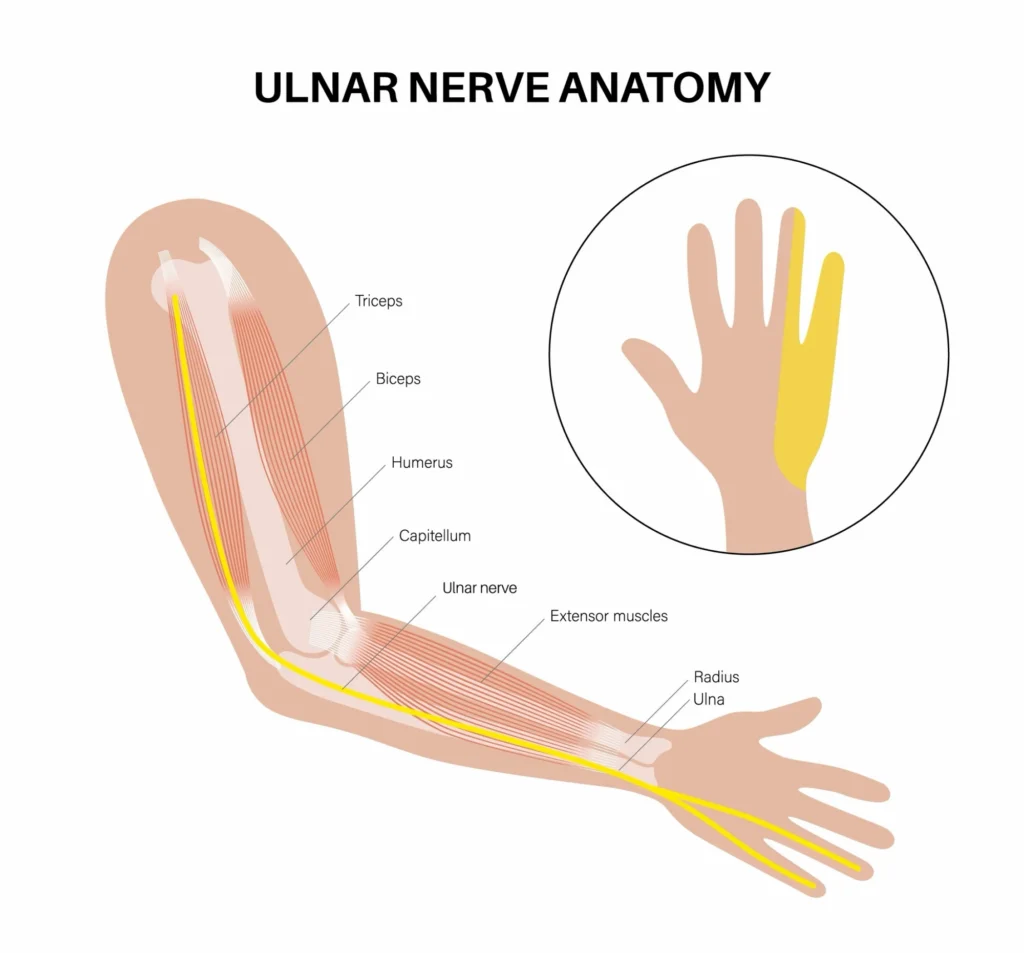
The ulnar nerve begins from nerve roots in the neck, travels down the inside of the arm, and ends in the hand. Along the way, it passes through two tight spaces where it has very little room to spare.
The first is the cubital tunnel, a groove on the inside of the elbow. This is the nerve you hit when you bump your “funny bone.” It sits just under the skin with almost no padding.
The second is Guyon’s canal, a small tunnel on the pinky side of the palm, near the base of the hand. By this point, the nerve has already given off a branch that supplies feeling to the back of the hand. That detail matters later, because it gives me a useful clue on exam.
The ulnar nerve provides feeling to the little finger and half of the ring finger, and it powers many of the small hand muscles that control pinch strength and fine movements.
What Causes Ulnar Nerve Entrapment?
At the Elbow
At the elbow, the biggest factor is usually position. When you bend your elbow, the cubital tunnel narrows and the nerve stretches around the bone. Holding that bent position for long stretches, such as sleeping with your arms curled under a pillow or holding a phone to your ear, can increase pressure on the nerve.
Leaning on the elbow is another common culprit. I see it in truck drivers who rest an arm on the window ledge and in office workers who prop their elbows on a desk or armrest all day. Old elbow fractures, arthritis, bone spurs, or a nerve that snaps out of its groove with bending can add to the problem.
At the Wrist
Entrapment in Guyon’s canal is less common. When it does happen, there is often a specific cause. A ganglion cyst pressing on the nerve is one of the more frequent findings. A fracture of a small wrist bone called the hook of the hamate can also be responsible. That injury sometimes shows up in golfers, baseball players, and tennis players after a hard swing.
Repeated pressure on the heel of the hand is the other big category. Cyclists who lean on their handlebars for hours, people who use vibrating tools, and workers who use the palm as a hammer may all be at higher risk. In my view, this is one of the more underrecognized hand problems. Many people assume any hand numbness must be carpal tunnel.
Symptoms and How They Point to a Location
Many patients with ulnar nerve entrapment describe some combination of the following:
- Numbness or tingling in the ring and little fingers
- Weakness or clumsiness with pinching, buttoning, or opening jars
- Symptoms that come and go at first, then become more constant
With elbow compression, symptoms frequently get worse when the elbow stays bent and may wake people up at night. There may be an ache along the inside of the elbow that runs down the forearm. The back of the hand on the pinky side may also feel numb, because the nerve is pinched before that branch splits off.
With wrist compression, the back of the hand usually feels normal. Pain, when present, tends to sit in the palm near the base of the little finger. Depending on which part of the nerve is squeezed, some people have mostly numbness, while others notice mostly weakness with little numbness at all. That second group worries me the most. Weakness without much tingling is easy to ignore until the muscles have already started to thin.
In advanced cases at either site, I may see muscle wasting between the thumb and index finger, which changes the urgency of my recommendations.
What I See in My Patients
The patients who come to me with ulnar nerve symptoms rarely arrive early. In my practice, the typical story is a year or more of “my hand falls asleep,” often blamed on sleep position or on carpal tunnel. By the time they are dropping coffee cups, the nerve has usually been irritated for a long time.
I also see a fair number of patients across the Sunnyvale and Kaufman area whose work puts steady pressure on the inner elbow or the palm. Long-haul drivers, warehouse workers, and people who spend their days on a keyboard with their elbows on hard armrests come up often in my ulnar nerve visits. For many of them, small changes to how they sit, drive, or sleep can do more than any medication.
I also watch for patients with more than one problem at once, such as compression at both the elbow and wrist, or a neck issue causing numbness in the same fingers.
How I Diagnose the Problem
My exam focuses on finding where the nerve is irritated. I tap along the nerve at the elbow and wrist, check feeling on both the palm and the back of the hand, test pinch strength, and examine the neck, since a pinched nerve root there can mimic ulnar nerve entrapment.
X-rays, and sometimes an MRI or CT scan, can help identify bone spurs, cysts, or fractures. In some cases, I may order a nerve conduction study and EMG. This test measures how well signals travel along the nerve. It can help show where the slowdown is and how severe it may be.
My Approach to Treatment
I do not believe in rushing to surgery for nerve symptoms that have a good chance of improving on their own. For mild to moderate ulnar nerve entrapment, I usually start with a structured trial of conservative care.
For compression at the elbow, that plan often includes:
- A splint or padded brace worn at night to keep the elbow relatively straight during sleep
- Avoiding leaning on the inner elbow and limiting long periods of deep elbow bending
- Nerve gliding exercises to help the nerve move more freely
- Anti-inflammatory medication when appropriate
For compression at the wrist, the focus shifts to taking pressure off the palm. That might mean padded cycling gloves, changing hand position on the handlebars, or modifying how a tool is gripped. A wrist splint may help calm things down.
Conservative treatment may take six to twelve weeks to show meaningful improvement. It works best when you stick with it. In my experience, the patients who wear the night splint every night, not just on bad nights, do better.
Surgery becomes a reasonable next step when symptoms persist despite a good trial of treatment, or sooner when testing shows significant nerve damage or I see muscle weakness or wasting. At the elbow, I may perform an endoscopic cubital tunnel release, which decompresses the nerve through small incisions with less scarring. For severe cases or unusual anatomy, a traditional open release, with or without moving the nerve to the front of the elbow, may be the better choice. You can read more about cubital tunnel treatment, including endoscopic release, in my post on cubital tunnel syndrome and how it is treated.
What Recovery Can Look Like
After an endoscopic release at the elbow, many patients may return to desk work within one to two weeks and full activities within two to three months. Severe or long-standing compression may take longer, since nerves heal slowly. Tingling often improves before strength does, and numbness that has been present for years may improve only partially. That is the main reason I encourage patients not to wait.
Summary
Ulnar nerve entrapment can start at the inner elbow or at the wrist. Each location has its own causes, symptom patterns, and treatment plan. Many patients improve with splints and simple changes to daily habits. Surgery is an option when the nerve needs more help.
If numbness in your ring and little fingers has lasted more than a few weeks, or if you are noticing weakness or clumsiness in your hand, I recommend getting an exam before the nerve has a chance to lose strength. You can request an appointment at my Sunnyvale or Kaufman office, and I will work with you to find where the nerve is pinched and what it needs.
Frequently Asked Questions
How can I tell if my numbness is coming from my elbow or my wrist?
A few clues can help. Symptoms that worsen with the elbow bent, wake you at night, and include numbness on the back of the hand may point toward the elbow. Numbness limited to the palm side, especially with pain near the heel of the hand, may point toward the wrist. An exam and, in some cases, a nerve conduction study are usually needed to know for sure.
Can ulnar nerve entrapment go away without surgery?
For many people with mild to moderate symptoms, yes. Night splinting, avoiding pressure on the nerve, and nerve gliding exercises often help over six to twelve weeks. If a cyst or fracture is causing compression at the wrist, conservative care may be less likely to solve the problem.
How long does it take to recover from ulnar nerve surgery?
It depends on the procedure. Most of my endoscopic cubital tunnel patients are back at a desk in a week or two and back to full activity in two to three months. The more damaged the nerve was beforehand, the longer it takes.
Is it safe to wait and see if my symptoms get better?
Brief, occasional tingling may be worth watching. Constant numbness, weakness, or thinning of the hand muscles is a different story. Those signs suggest the nerve is under significant pressure, and I recommend an evaluation rather than waiting.