

When your shoulder suddenly gives way, or never quite feels right after a dislocation, a Bankart tear may be the reason why. This type of injury affects a specific structure inside the shoulder joint that plays a role in keeping everything stable. Without it functioning properly, the joint can feel loose, unpredictable, and frankly exhausting to manage.
Bankart tears are relatively common, particularly in younger patients and athletes who participate in contact or overhead sports. But they don’t only happen to athletes. A bad fall, a collision, or even a single traumatic event can set the whole process in motion. The encouraging part? This is a well-understood injury with a range of effective treatment options.
Key Takeaways
- A Bankart tear is a labral injury at the front-bottom of the shoulder socket, most often caused by a shoulder dislocation.
- Common symptoms include shoulder instability, apprehension with overhead movements, a catching or clicking sensation, and pain at the front of the joint.
- Not every Bankart tear requires surgery. Treatment depends on your age, activity level, the severity of the damage, and your history of dislocations.
Understanding Your Shoulder
To make sense of a Bankart tear, it helps to start with a quick look at shoulder anatomy. The shoulder is a ball-and-socket joint, but it’s an intentionally shallow one. The relative shallowness of the joint is what gives your shoulder its incredible range of motion. You can reach overhead, across your body, behind your back, and in almost every direction imaginable.
The trade-off, though, is stability. A deep socket, like the hip, keeps the joint firmly in place. The shoulder sacrifices some of that security in exchange for mobility. To compensate, the shoulder relies on a rim of fibrocartilage called the labrum. This structure lines the edge of the shoulder socket (called the glenoid) and deepens it slightly; think of it like a suction cup that helps hold the ball of the upper arm bone in place.
The labrum also acts as an anchor point for key stabilizing ligaments. When it’s intact, the system works well. When it tears, the shoulder’s ability to stay centered in the socket may be compromised.
What Is a Bankart Tear?
A Bankart tear is a specific type of labral tear that occurs at the front-bottom portion of the shoulder socket. When the shoulder is forcefully pushed out of position, the labrum can tear away from the glenoid at this front-lower attachment point. In some cases, a small fragment of bone breaks off from the socket rim along with the labral tissue. This variation is referred to as a bony Bankart tear, and it may require a different treatment approach than a soft-tissue-only injury.
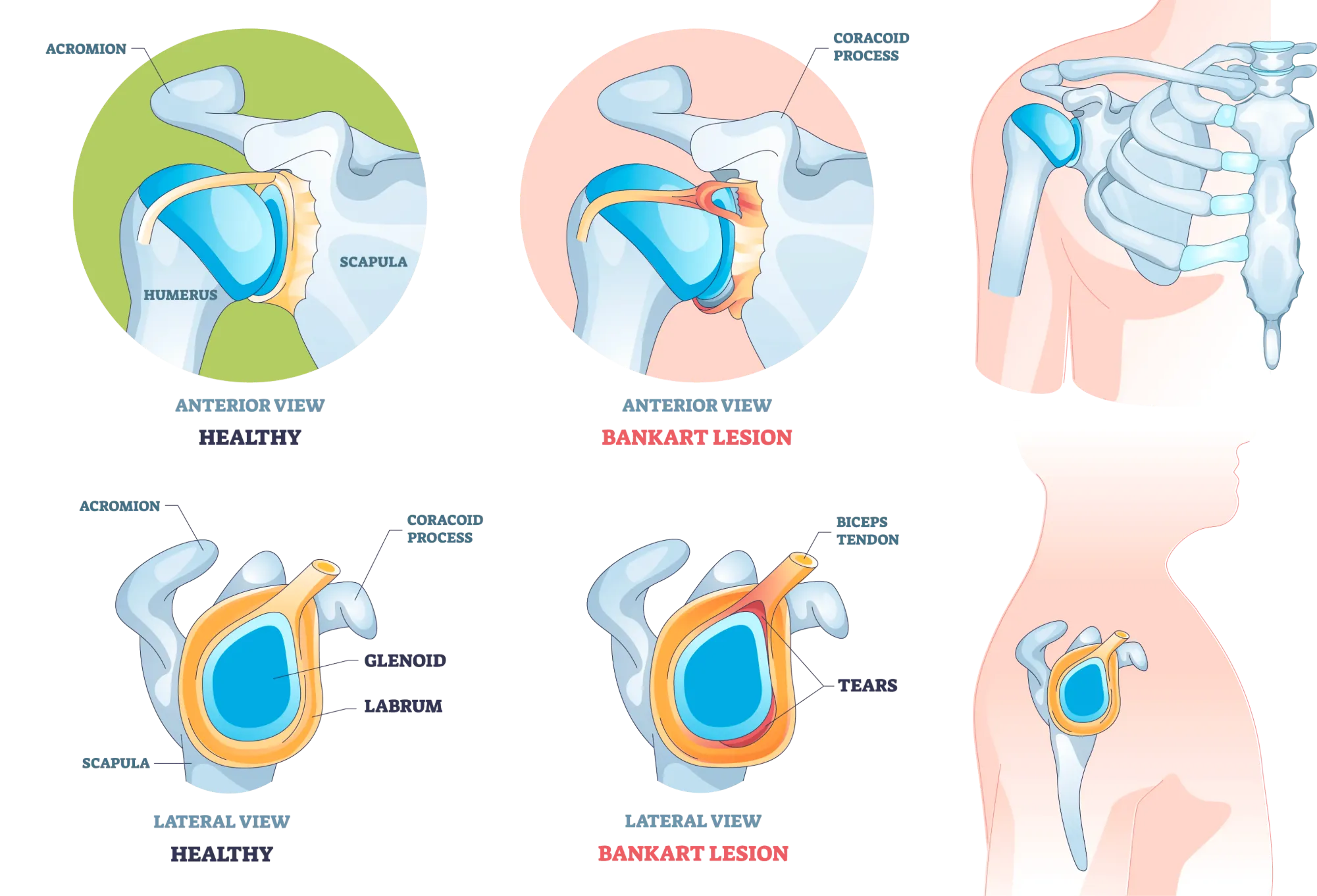
It’s worth knowing that a Bankart tear doesn’t always announce itself dramatically. Some patients feel instability right away; others may notice only mild discomfort that gradually worsens, particularly if they return to activity without a proper evaluation.
What Causes a Bankart Tear?
Bankart tears are almost always caused by a traumatic event that forces the shoulder out of its normal alignment. The most common culprit is an anterior shoulder dislocation, where the ball of the joint slips forward out of the socket. That sudden, forceful movement tears the labrum away from the bone at its weakest attachment point.
Some of the most frequent causes include:
- A tackle, collision, or fall during contact sports like football, hockey, wrestling, or rugby
- A fall onto an outstretched hand, which sends force up through the arm and into the shoulder joint
- Overhead sports like volleyball, baseball, or tennis, where repetitive stress may gradually compromise the labrum over time
- Direct blows to the shoulder during work-related accidents or everyday falls
- Reaching behind the body at an awkward angle with significant force
Age can play a role as well. Younger patients, particularly teenagers and adults in their twenties, tend to experience higher rates of recurrent instability after a first-time dislocation.
Recognizing the Symptoms
Symptoms of a Bankart tear can range quite a bit depending on the severity of the damage and how long ago the injury occurred. Some patients deal with ongoing discomfort. Others may have more subtle signs that only show up during specific activities.
Common symptoms may include:
- A feeling that the shoulder is loose, shifting, or “about to give out,” especially during overhead activity or reaching behind the body
- Apprehension, or a persistent sense of anxiety when lifting the arm to the side or overhead, even without active pain
- Pain at the front of the shoulder, often worsening with certain arm positions
- A catching, clicking, or grinding sensation inside the joint during movement
- Weakness or reduced confidence in the shoulder when throwing, pushing, or carrying
- Recurring episodes of partial or complete shoulder dislocations
Even when the shoulder isn’t actively painful, the feeling that it might slip out of place can affect athletic performance, sleep quality, and everyday confidence. Many patients describe putting the affected arm in protective positions without even thinking about it, and that kind of compensation can signal that something deeper is going on.
Getting a Diagnosis
If you’ve experienced a shoulder dislocation, or if your shoulder has been feeling unstable, clicking, or painful, a thorough evaluation with an experienced shoulder specialist is the appropriate next step. Your doctor typically begins with a detailed conversation about when your symptoms started, what caused them, and how they’ve changed over time.
A hands-on physical examination follows, including specific tests designed to assess shoulder stability and detect signs of labral involvement. These maneuvers apply controlled stress to the joint in a way that can reveal instability or trigger apprehension that points toward a labral injury.
Imaging tests may be ordered to round out the diagnostic picture. X-rays can identify bone fractures and may reveal a bony Bankart lesion. For a detailed look at the labrum itself, which doesn’t show up well on standard X-ray, an MRI is usually the preferred next step.
Non-Surgical Treatment Options
Not every Bankart tear requires surgery. For some patients, conservative management may be a reasonable first approach, particularly for first-time dislocations in older, less active individuals, or in cases where the instability is mild.
Conservative care typically involves an initial period of immobilization in a sling to allow acute inflammation to settle down. After that, a structured physical therapy program commonly focuses on strengthening the muscles surrounding the shoulder, especially the rotator cuff and the periscapular stabilizers, to help compensate for the reduced function of the labrum. Modifying activity levels during this period can also reduce the risk of re-injury while the shoulder is still recovering.
It’s important to be realistic about what conservative treatment can and can’t do, though. Physical therapy can build strength and improve function, but it does not directly repair the torn labrum itself. For many patients, particularly those who are young, active, or who have experienced multiple dislocations, non-surgical management may not provide enough stability to allow a safe return to full activity. If symptoms persist or instability continues, surgery is often worth a closer look.
Surgical Treatment: Bankart Repair
When surgery is the recommended path, the most common procedure for a Bankart tear is called a Bankart repair. In most cases, this procedure can be performed arthroscopically, which means it’s done through small incisions using a thin camera and specialized tools, rather than through a large open incision.
During the procedure, the surgeon reattaches the torn labrum back to the rim of the shoulder socket using small suture anchors that hold the tissue firmly in its correct position. Over time, the labrum is expected to heal back to the bone and restore shoulder stability.
That said, not every case is ideal for an arthroscopic approach. When significant bone loss is involved, a procedure like a Latarjet may be considered. In a Latarjet procedure, a small piece of bone is transferred to the front of the socket to rebuild the lost rim and restore the shoulder’s structural foundation.
Summary
A Bankart tear is an injury to the shoulder labrum, commonly caused by dislocations. Whether your path leads toward physical therapy, surgical repair, or a combination of both, there are many options available to help restore your shoulder’s stability and get you back to doing the things you love. The most important step is getting an accurate diagnosis and a personalized treatment plan from a specialist who understands shoulder instability.
Frequently Asked Questions
Can a Bankart tear heal on its own without surgery?
Conservative treatment, including rest, immobilization, and physical therapy, may help manage symptoms, particularly after a first-time dislocation in an older or less active patient. However, the torn labrum itself doesn’t typically repair on its own without surgical intervention. For many patients, especially younger and more active individuals, non-surgical management may not provide enough lasting stability, and surgery may eventually be recommended.
Is a Bankart tear the same as a labral tear?
A: A Bankart tear is a type of labral tear, but the two terms aren’t interchangeable. The labrum can tear at different locations around the socket, and each type has its own name and characteristics. A Bankart tear specifically refers to a tear at the front-bottom portion of the labrum, the location most commonly associated with anterior shoulder dislocations.
What is a bony Bankart tear, and how is it different?
A bony Bankart tear is a variation in which a fragment of bone from the edge of the shoulder socket breaks off along with the torn labral tissue. This can make the injury more complex to treat, since the socket itself loses structural material. Depending on how much bone is lost, a Latarjet procedure, in which a bone graft is used to rebuild the socket rim, may be more appropriate than a standard Bankart repair.