

Your shoulder helps you reach, lift, throw, and carry out countless daily tasks. When something goes wrong, you feel it quickly. The most common shoulder problems range from soft tissue injuries like rotator cuff tears to degenerative conditions like arthritis, and each one presents its own set of challenges. In this guide, we’ll walk through the conditions that bring patients into our office most frequently, how they’re typically diagnosed, and what treatment options may be available.
Key Takeaways
- Rotator cuff tears, shoulder impingement, frozen shoulder, arthritis, dislocations, and labral tears are among the most common shoulder problems.
- Many shoulder conditions share overlapping symptoms like pain, stiffness, and weakness, which is why a thorough evaluation by a specialist can be important for an accurate diagnosis.
- Treatment may begin with conservative approaches such as physical therapy, anti-inflammatory medications, and activity modification before surgical options are considered.
Why Your Shoulder Is Built for Movement and Vulnerable to Injury
Before diving into specific conditions, it helps to understand why the shoulder is prone to injuries. The shoulder is a ball-and-socket joint, but unlike the hip, which is a deep, stable socket, the shoulder’s socket is relatively shallow. Think of it like a golf ball sitting on a tee. This design gives you a remarkable range of motion, but it also means the joint relies heavily on soft tissues for stability.
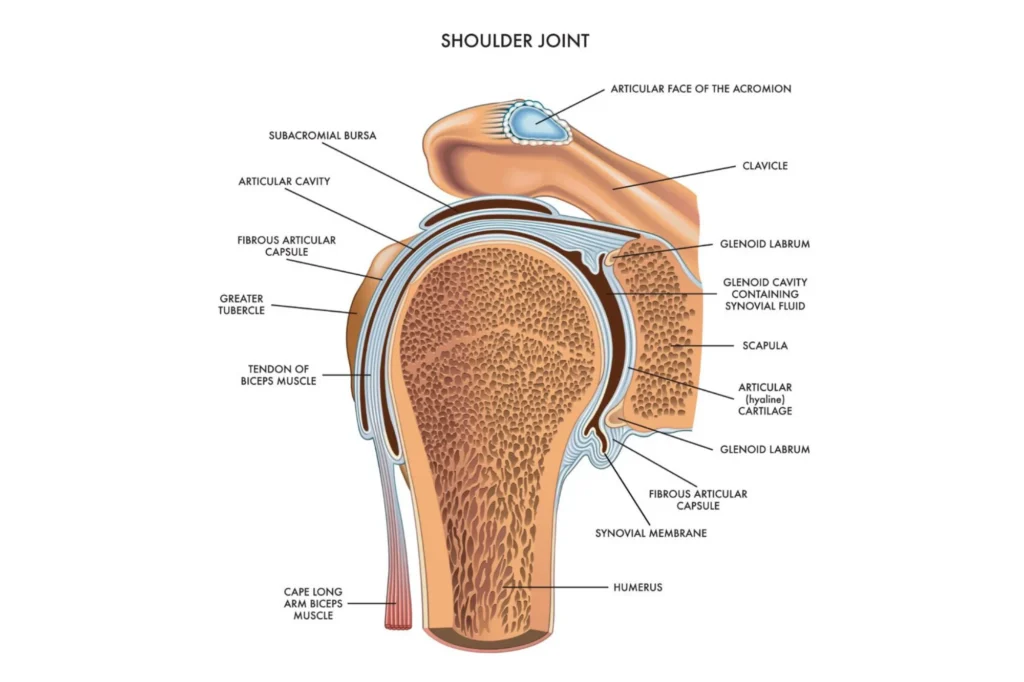
The rotator cuff, a group of four muscles and their tendons, plays a central role in keeping the ball of the upper arm bone (humerus) centered in the socket. Ligaments, the labrum (a ring of cartilage around the socket), and the joint capsule all contribute additional support. When any of these structures sustain damage, the result can be pain, limited motion, and difficulty performing even simple activities.
This inherent trade-off between mobility and stability is a big part of why shoulder problems are so common. It also explains why so many different conditions can affect this one joint.
The Most Common Shoulder Problems
Rotator Cuff Tears
Rotator cuff tears are among the most frequently diagnosed shoulder conditions. These tears can happen suddenly, such as from a fall or heavy lifting, or they can develop gradually over months or years.
A partial tear means the tendon is damaged but not completely severed. A full-thickness tear goes all the way through the tendon. Patients with rotator cuff tears often report pain that worsens at night, weakness when lifting or rotating the arm, and a crackling sensation during shoulder movement. Some people experience a sudden, sharp pain after an injury, while others notice a slow, progressive decline in function.
Not every rotator cuff tear requires surgery. Smaller tears and partial tears may respond well to physical therapy, rest, and anti-inflammatory medications. However, larger or more symptomatic tears may benefit from surgical repair, particularly if conservative treatment does not provide adequate relief.
Shoulder Impingement Syndrome
Shoulder impingement syndrome occurs when the tendons of the rotator cuff become compressed as they pass through a narrow space beneath the acromion, a bony projection at the top of the shoulder blade. This compression can irritate and inflame the tendons, leading to pain, especially with overhead movements.
Impingement is particularly common in people who perform repetitive overhead activities. Athletes who swim, play tennis, or throw frequently may be at higher risk, as can individuals whose jobs require repeated reaching above shoulder height. The condition can also develop alongside rotator cuff tendinitis or bursitis.
Patients with impingement typically describe pain when raising the arm, reaching behind the back, or sleeping on the affected side. The pain may start as a mild annoyance and gradually become more persistent. Physical therapy focused on strengthening and improving shoulder mechanics may be recommended. If symptoms persist despite conservative care, surgery may be considered.
Frozen Shoulder (Adhesive Capsulitis)
Frozen shoulder is one of the more frustrating conditions patients encounter. It involves a progressive tightening and thickening of the joint capsule, which severely limits the shoulder’s range of motion. The condition typically progresses through three stages: a freezing stage marked by increasing pain, a frozen stage characterized by significant stiffness with potentially less pain, and a thawing stage where motion gradually returns.
This process typically lasts between one and three years, although the duration can vary from person to person. Frozen shoulder appears to be more common in women, individuals between the ages of 40 and 60, and those with diabetes or thyroid disorders. It can also develop after a period of immobilization following surgery or injury.
Treatment often focuses on physical therapy and gentle stretching exercises designed to restore range of motion. Anti-inflammatory medications and corticosteroid injections may help manage pain during the freezing phase. In some cases, if progress stalls, a manipulation under anesthesia or an arthroscopic capsular release may be considered to break up the scar tissue restricting movement.
Shoulder Arthritis
Arthritis in the shoulder involves the gradual breakdown of the cartilage that cushions the joint surfaces. The most common type is osteoarthritis, often called “wear-and-tear” arthritis. It usually develops slowly and becomes increasingly common as we age. However, arthritis can also result from autoimmune conditions like rheumatoid arthritis, prior injuries (post-traumatic arthritis), or long-standing rotator cuff tears (rotator cuff tear arthropathy).
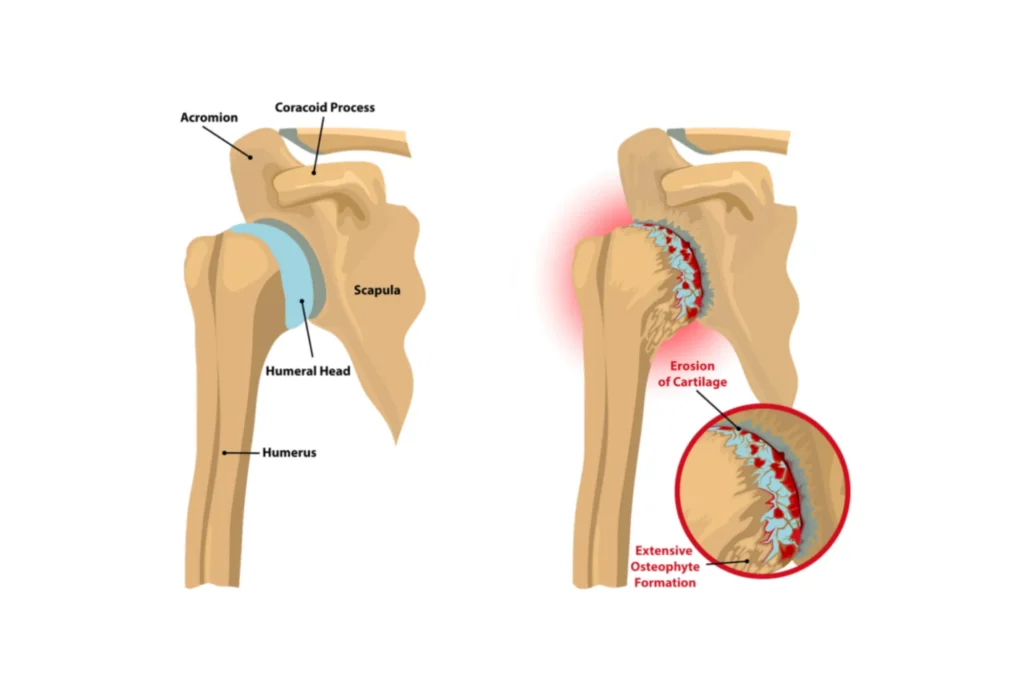
Patients with shoulder arthritis tend to notice a deep, aching pain that worsens with activity. Stiffness is another potential symptom, making it difficult to reach overhead or behind the back. As the cartilage wears away, bone may begin rubbing against bone, and patients sometimes report a grinding sensation with movement.
When shoulder arthritis is mild to moderate, treatment may include activity modification, physical therapy, anti-inflammatory medications, and joint injections. For more advanced cases where conservative methods no longer provide sufficient relief, shoulder replacement surgery may become a recommended option. Depending on the condition of the rotator cuff and the pattern of arthritis, either a total shoulder replacement or a reverse shoulder replacement may be appropriate.
Shoulder Instability and Dislocations
A shoulder dislocation happens when the ball of the humerus is forced out of the socket. This is often a traumatic event, such as a hard fall, a collision during sports, or a forceful blow to the shoulder. The first dislocation can be extremely painful and usually requires medical assistance to reposition the joint.
Once the shoulder dislocates, the ligaments and labrum may be stretched or torn. This damage can make the joint less stable and more likely to dislocate again, particularly in younger, more active patients. Some individuals develop chronic instability, where the shoulder feels loose or “slips” during certain movements without a full dislocation.
Initial treatment for a first-time dislocation generally involves immobilization followed by physical therapy to rebuild strength and stability around the joint. For patients who experience repeated dislocations or persistent instability, surgical stabilization, often performed arthroscopically, may be recommended to repair the damaged structures and reduce the likelihood of future episodes.
Labral Tears
The labrum is a ring of tough, fibrous cartilage that lines the rim of the shoulder socket. It deepens the socket, helps hold the humeral head in place, and serves as an attachment point for several ligaments. When the labrum tears, it can compromise both stability and comfort.
Labral tears can occur from acute injuries, like a fall onto an outstretched hand or a sudden pull on the arm, or from repetitive overhead motions. They are relatively common in throwing athletes and individuals who perform a lot of overhead work. A specific type known as a SLAP tear (Superior Labrum Anterior and Posterior) affects the top portion of the labrum where the biceps tendon attaches.
Symptoms may include a catching or locking sensation in the shoulder, pain with overhead activity, and a general feeling of instability. Treatment depends on the type and severity of the tear. Physical therapy may help manage symptoms in some cases, while surgical repair through arthroscopy is often considered for tears that cause persistent pain or instability.
How These Conditions Are Typically Diagnosed
Because many of the most common shoulder problems share similar symptoms, such as pain, stiffness, weakness, and reduced range of motion, arriving at an accurate diagnosis requires a careful process. Your doctor will typically begin with a detailed conversation about your symptoms, including when they started, what makes them better or worse, and whether you recall a specific injury.
A physical examination follows. Your doctor may test your shoulder’s range of motion, assess strength in specific muscle groups, and perform specialized maneuvers designed to stress particular structures within the joint. Imaging studies may be ordered to support the diagnosis. X-rays can reveal arthritis, bone spurs, fractures, and alignment issues. An MRI may be ordered for a detailed look at soft tissues like the rotator cuff tendons, labrum, and joint capsule. In some situations, a CT scan provides a more detailed view of bone anatomy, particularly when surgical planning is needed.
Treatment Paths: From Conservative Care to Surgical Options
One of the most important things to understand about treating shoulder problems is that surgery is rarely the first step. For the majority of conditions, shoulder specialists begin with conservative, non-surgical treatment and monitor how the patient responds over time.
Conservative treatment may involve several complementary approaches. Physical therapy is a common component, aiming to strengthen the muscles around the shoulder, improve flexibility, and restore proper movement patterns.
Medications play a supporting role. Over-the-counter nonsteroidal anti-inflammatory drugs (NSAIDs) like ibuprofen may help reduce both pain and swelling. In some cases, your doctor may recommend a corticosteroid injection directly into the joint or the subacromial space for more targeted relief.
Activity modification is another element. This does not necessarily mean stopping all activity. Rather, it often means adjusting how you perform certain tasks to reduce strain on the shoulder. Your doctor can help identify specific movements to avoid and suggest alternatives.
When conservative treatment does not provide adequate improvement after a reasonable period, or when the condition is severe from the outset, surgical intervention may be recommended. The type of surgery depends entirely on the specific condition. An experienced shoulder specialist can help guide the most appropriate treatment path for you.
Summary
The most common shoulder problems can affect the shoulder in distinct ways. The shoulder’s remarkable range of motion comes with a trade-off in stability, and that balance makes it susceptible to both acute injuries and gradual wear. The encouraging news is that many treatment options exist for each of these conditions. Some patients find relief through non-surgical approaches like physical therapy, medications, and lifestyle adjustments. For those who need surgery, modern techniques, from minimally invasive arthroscopy to shoulder replacement, continue to advance.
Frequently Asked Questions
What are the most common shoulder problems?
The most common shoulder problems include rotator cuff tears, shoulder impingement syndrome, frozen shoulder (adhesive capsulitis), shoulder arthritis, shoulder dislocations and instability, and labral tears. These conditions can result from acute injuries, repetitive use, or gradual degeneration over time.
How do I know if my shoulder pain is serious?
Shoulder pain may warrant evaluation if it is persistent, worsens over time, disrupts your sleep, or makes daily tasks difficult. Sudden weakness, an inability to move the shoulder, or a feeling that the joint is unstable are additional signs that you should consider seeing a specialist.
Can shoulder problems heal without surgery?
Many shoulder conditions respond well to non-surgical treatment. Physical therapy, anti-inflammatory medications, injections, and activity modification may provide meaningful relief for a range of problems. Your doctor can help determine whether conservative care is a good starting point for your specific situation.