

Medically reviewed by Jeff Zhao, DO
Patients who come to my Sunnyvale and Kaufman offices with a finger that catches or locks tend to start with the same question: “Did I do something to cause this?” A finger that snaps straight like a pocketknife, or one you have to uncurl with your other hand in the morning, feels like it must have a reason behind it. The answer to what causes trigger finger is usually less dramatic than people expect. There is rarely a single injury or activity to blame.
Key Takeaways
- Trigger finger happens when a finger tendon and the tunnel it slides through no longer fit well together. The tendon catches instead of gliding.
- Many cases have no clear cause. It does show up more often in women in midlife, in people with diabetes or rheumatoid arthritis, and in people who grip a lot.
- Rest, splinting, or an injection may be enough for many patients. Surgery may be a reasonable next step when the finger keeps locking after an extended trial of nonsurgical care.
How a Healthy Finger Tendon Moves
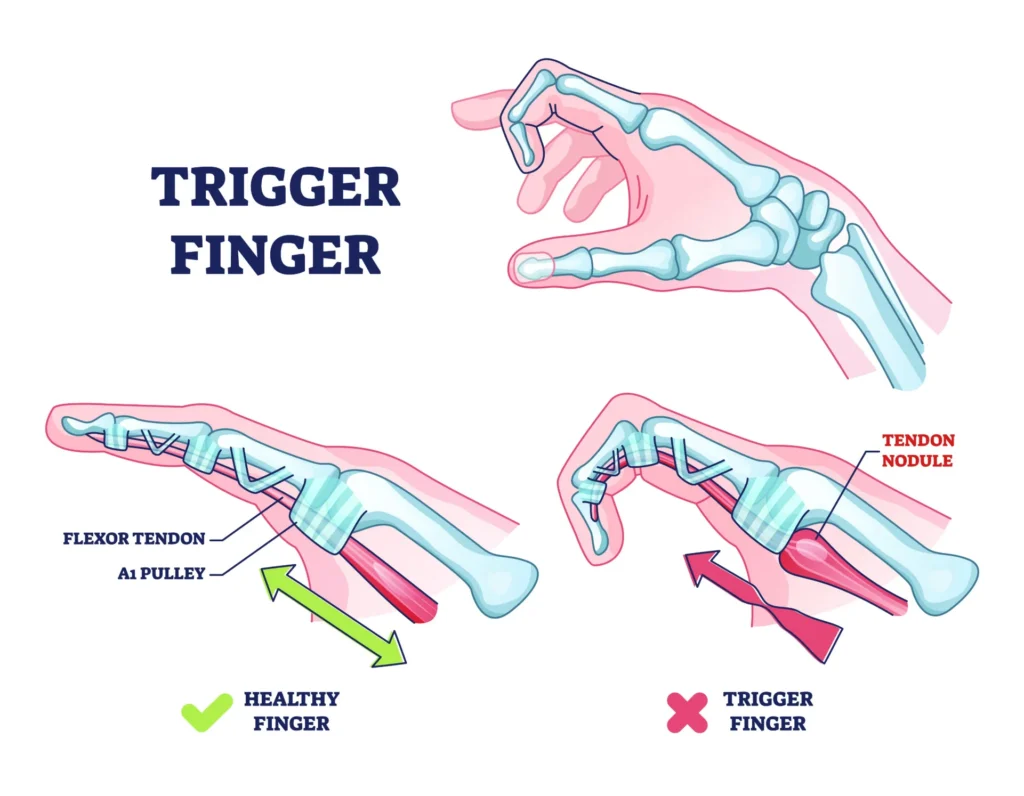
Your fingers bend thanks to long, cord-like flexor tendons. They run from the muscles in your forearm, through your palm, and into the finger bones. To keep those tendons close to the bone, each one passes through a series of snug tunnels called pulleys. Picture a rope sliding through a row of rings, and you have the basic idea.
The key pulley here is the A1 pulley. It sits in the palm right at the base of each finger and thumb. When the tendon and the pulley fit well, the tendon slides through it all day long without you noticing a thing.
What Causes Trigger Finger?
Trigger finger, also called stenosing tenosynovitis, starts with a size problem. The tendon may thicken or form a small bump. The A1 pulley may thicken and narrow at the same time. With less room in the tunnel, the tendon can no longer glide smoothly. It catches at the entrance of the pulley, then pops through, which produces that familiar click or snap.
Many cases of trigger finger have no clear cause, and symptoms frequently begin without any change in activity. In other words, a locking finger is not likely to be the result of one long weekend of yard work. Even so, certain groups develop it more than others:
- Women in midlife: Trigger finger is more common in women between the ages of 40 and 60. Children rarely get it.
- People with certain medical conditions: Diabetes and rheumatoid arthritis are both linked to a higher risk. Amyloidosis, a less common condition, is another.
- People who grip or pinch all day: Repetitive gripping or pinching, at work or during a hobby, may play a role.
- Natural differences in tendon structure: Some people seem to have anatomy that leaves less room to spare.
Trigger finger can involve one finger or several, in one hand or both. The ring finger and thumb top the list. When the thumb is the one locking, the condition is called trigger thumb.
Signs That Point to Trigger Finger
Symptoms tend to creep in slowly rather than appearing overnight. Early on, many people notice a tender lump at the base of the finger on the palm side. Others notice a subtle catch when they make a fist. Over time, that catch may turn into a true pop or lock.
Two details help me separate trigger finger from other hand problems. First, stiffness and locking are frequently worst first thing in the morning. They then loosen up as the hand warms up during the day. Second, the pain generally sits at the base of the finger in the palm, even when it feels like the problem lives in the knuckle. In more advanced cases, the finger may stay bent until you straighten it with your other hand.
What I See in My Patients
In my practice, patients with trigger finger regularly come in convinced they have arthritis in the knuckle, because that is where the finger seems to stick. When I press on the base of the finger in the palm and feel the tendon catch, the conversation changes. In a lot of these cases, the joint itself looks healthy.
Across the communities east of Dallas, I also see patients who have a second hand complaint at the same visit. Numbness and tingling from carpal tunnel syndrome sometimes show up in the same hand, so I check for carpal tunnel during the same exam. My fellowship training at the San Francisco Shoulder & Upper Extremity program under Dr. Tom Norris focused on the arm as a whole. One lesson from that year is that the hand rarely works in isolation.
I also pay close attention to patients with diabetes. Trigger finger shows up more in this group, and their treatment plan may look a little different.
How I Diagnose Trigger Finger
Diagnosis usually comes down to a careful conversation and a hands-on exam. I check for tenderness over the tendon in the palm, thickening at the base of the finger, and the catch itself as you bend and straighten. X-rays and other tests are typically not needed to confirm trigger finger. I may still order imaging if the exam suggests arthritis, an old injury, or another source of pain.
When a patient describes numbness along with the locking, I also examine the wrist and elbow. Nerve problems such as ulnar nerve entrapment are another possible source of symptoms in the same fingers. Sorting those out early helps me build the right plan.
My Approach to Treatment
I do not believe in rushing to surgery for a problem that has a good chance of improving with simpler care. Especially early on, I start with a conservative plan. That plan may include:
- Resting the hand and cutting back on repetitive gripping or pinching
- A splint worn at night to keep the finger straight while you sleep
- Over-the-counter anti-inflammatory medication, when it is safe for you
- Gentle stretching to ease stiffness
If those steps are not enough, a cortisone injection at the base of the finger is another option I consider. It is a quick office procedure. For some patients, it can calm the tendon enough to stop the triggering. If symptoms return, a repeat injection may be considered.
Surgery may be a reasonable next step when the finger keeps locking after an extended trial of nonsurgical care. It is also worth discussing when the finger is stuck in a bent position and will not straighten. The procedure, called a trigger finger release, opens the A1 pulley so the tendon has room to glide again. It is an outpatient procedure done with local numbing, so patients go home the same day. Depending on the case, the pulley is released through a small incision in the palm or with the tip of a needle. Releasing the A1 pulley is not expected to weaken the hand, as long as the other pulleys stay in place.
Outside the office, I windsurf and snowboard, so I understand how much of daily life depends on a grip you trust. My goal is to restore that grip with the least invasive option that is likely to work.
What Recovery Can Look Like
Timelines may vary between patients, but recovery after a trigger finger release follows a gradual progression. Finger movement starts right after surgery. Some soreness in the palm is normal. Keeping the hand raised above the level of the heart can help with pain and swelling.
The incision generally heals within a few weeks. Swelling and stiffness, on the other hand, might take four to six months to settle completely. On average, people feel fully recovered at around six months. If stiffness or swelling lingers, working with a hand therapist is often helpful. Complications are uncommon but can include infection, stiffness, or a return of the triggering, and I review these risks with each patient before scheduling surgery.
Summary
Trigger finger develops when a finger tendon and the A1 pulley it slides through no longer fit well together. The tendon catches, pops, or locks as a result. When patients ask me what causes trigger finger, the answer is that no single event is usually to blame. Women in midlife, people with diabetes or rheumatoid arthritis, and people who grip and pinch for a living do develop it at higher rates, though. Rest, splinting, or an injection helps a good share of patients, and a trigger finger release may be an option if those steps fall short.
If a finger has been catching or locking for more than a few weeks, request an appointment at my Sunnyvale or Kaufman office.
Frequently Asked Questions
Can trigger finger go away on its own?
Mild cases sometimes settle down with rest and by avoiding the activities that aggravate them. For many people, though, a night splint or an injection is what it takes to stop the catching.
Can typing or using my phone cause trigger finger?
In many cases, trigger finger has no clear cause, so it is hard to blame any one activity. Repetitive gripping and pinching might play a role for certain people, and heavy hand use can make existing symptoms more noticeable. If texting or typing seems to set off the catching, short breaks and a different way of holding the device are worth trying.
Does diabetes make trigger finger more likely?
Yes, diabetes is linked to a higher risk of trigger finger. Cortisone injections are also less likely to work in people with diabetes, and the steroid might temporarily raise blood sugar. For those reasons, I build treatment plans for these patients with their blood sugar control in mind.
When should I see a doctor for a locking finger?
I recommend an evaluation if a finger has been catching for more than a few weeks. The same goes for a finger that locks and needs your other hand to straighten it, or one that will not straighten at all. A finger stuck in a bent position deserves prompt attention, since it could need treatment sooner.