

Medically reviewed by Jeff Zhao, DO | Reviewed August 2026
An elbow fracture tends to arrive in a similar way for many of my patients in Sunnyvale and Kaufman: a fall on an outstretched hand, a car accident, or a hard direct hit to the elbow, followed by pain sharp enough that moving the arm at all feels impossible. Once the initial shock passes, the questions I hear most are about elbow fracture recovery, including how long it takes, whether surgery will be needed, and when normal use of the arm comes back. This post walks through what I look for after an elbow fracture and what recovery realistically looks like.
Key Takeaways
- Elbow fractures range from simple, non-displaced breaks to complex injuries involving multiple bones and ligaments.
- Treatment depends heavily on whether the bone fragments have shifted out of alignment.
- Simple fractures often heal with a splint or cast, while displaced fractures typically need surgical fixation.
- Elbow fracture recovery timelines commonly range from six weeks for simple injuries to several months for complex ones.
Understanding Elbow Fractures
The elbow is a hinge joint formed by three bones, the humerus, radius, and ulna, held together by strong ligaments on both the inner and outer sides. A fracture can involve any one of these bones, or more than one at once, and can occur with or without an accompanying dislocation of the joint.
Most elbow fractures I see result from a fall onto an outstretched hand or a direct impact to the elbow itself, whether from a car accident, a sports collision, or a fall from a ladder or bike. Symptoms typically include severe pain, rapid swelling, visible deformity in more significant injuries, and an inability to bend or straighten the arm. Numbness or tingling in the hand can also occur when swelling or bone displacement puts pressure on nearby nerves, and that combination always moves a patient to the front of the line for evaluation.
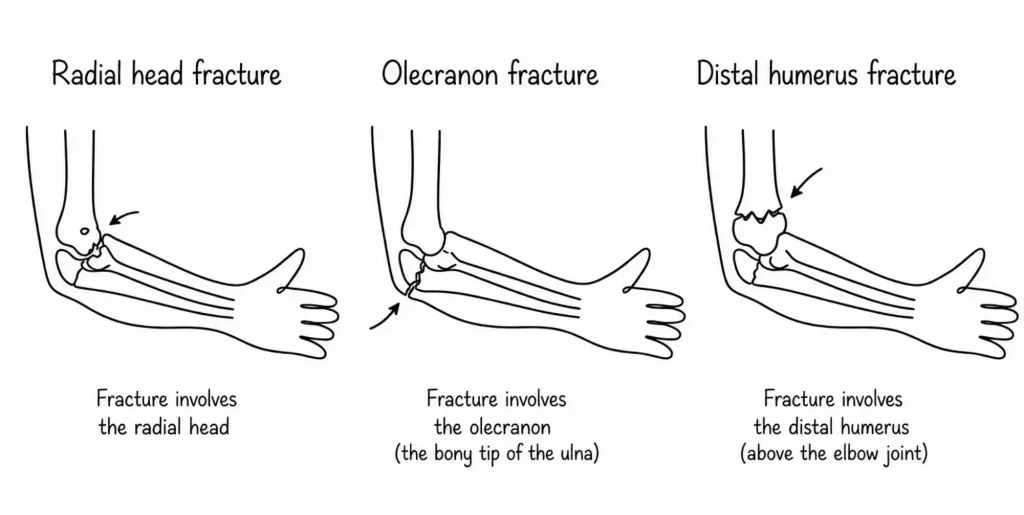
Elbow fractures can be grouped by which bone is broken. A radial head fracture involves the smaller bone on the outer side of the elbow and is one of the more common patterns I see after a fall on an outstretched hand. An olecranon fracture affects the bony point of the elbow you rest on a table, and often results from a direct fall onto that point. A distal humerus fracture involves the bottom of the upper arm bone and tends to occur with higher-energy trauma, such as a car accident or a fall from height. Each pattern behaves differently and calls for its own treatment considerations, which is part of why an accurate diagnosis matters so much before a treatment plan gets built.
How Elbow Fractures Are Evaluated
X-rays are the starting point for almost every elbow fracture evaluation. They show whether the fracture is displaced, meaning the bone fragments have shifted out of their normal alignment, or non-displaced, where the bone has broken but stayed in position. This distinction drives most of the treatment decision. A CT scan sometimes adds detail for more complex fracture patterns, particularly when surgical planning requires a precise picture of how the fragments are arranged.
I also check the nerves and blood flow in the hand carefully during the initial exam. The nerves that control hand and finger function run close to the elbow, and a significant fracture or dislocation can put them at risk. This is not something I skip, even when a patient is understandably more focused on the pain than on a nerve exam. It is one of several reasons I encourage anyone with a suspected elbow injury to get evaluated promptly rather than waiting.
What I See in My Patients
A meaningful portion of the elbow fractures I treat fall into two groups that look very different from each other. The first is younger, active patients who fracture the elbow in a fall from a bike, a skateboard, or during sports. These fractures are higher energy, and I frequently see them alongside other injuries earned from the same fall.
The second group is older patients, frequently after a ground-level fall at home. I treat a fair number of these cases, where I also watch closely for elbow arthritis or reduced bone density, either of which can complicate the fracture pattern and slow the healing process.
In both groups, I have found that an important (and controllable) factor for the outcome is not the fracture pattern itself but how quickly and consistently the patient engages with therapy once the bone is stable enough to allow motion. I am direct with my patients about this: the elbow stiffens up faster than almost any other joint in the body. A knee or shoulder may tolerate a longer period of rest before stiffness becomes a real problem. The elbow does not extend that same courtesy, which shapes a lot of my treatment decisions.
My Approach to Treatment
For simple, non-displaced fractures, I typically recommend a period of immobilization in a splint or cast, followed by a supervised return to motion. I do not like leaving an elbow immobilized any longer than necessary, since prolonged stiffness can become a bigger long-term problem than the original fracture.
For displaced fractures, I may recommend surgical fixation with plates, screws, or pins to restore proper alignment. My reasoning is straightforward. A well-aligned, stable elbow allows earlier, safer motion, and earlier motion is one of the best tools I have for preventing the stiffness that can limit elbow function long after the bone itself has healed. I would rather fix a fracture properly the first time than manage a stiff, poorly aligned elbow months later.
Pain control matters during this stretch too, both for comfort and because poorly managed pain can quietly limit how much a patient participates in early motion and therapy. I typically start with elevation, ice, and an appropriate pain medication, tapering as swelling and discomfort ease. If pain suddenly worsens instead of gradually improving, that is worth a call to my office rather than waiting for the next scheduled visit.
When a fracture occurs alongside a dislocation, or when ligaments are torn in addition to the bone injury, treatment becomes more involved and often includes repair of both the bony and soft tissue components. Physical therapy starts early in these cases as well, beginning with gentle, protected range-of-motion exercises before progressing to strengthening once the repair has had adequate time to stabilize.
Elbow Fracture Recovery Timeline
Recovery from a simple, non-displaced fracture managed with immobilization typically takes around six to eight weeks for the bone itself to heal, with continued therapy afterward to fully restore motion and strength.
More complex fractures that require surgery often need three to six months for adequate bone healing and rehabilitation before an elbow feels close to normal again. Return to contact sports or physically demanding labor tends to take longer still, commonly in the range of six to nine months, to allow both the bone and the surrounding soft tissue time to fully recover.
These timelines vary from patient to patient based on the specific fracture pattern, age, bone quality, and how consistently a patient follows the therapy program. I would rather give patients an honest, individualized estimate at each visit than a single number on day one that may not hold up as we learn more about how the elbow is healing.
A few signs during recovery deserve prompt attention rather than a wait-and-see approach: increasing swelling or redness around a surgical incision, fever, new numbness or tingling that was not present at the initial injury, or pain that escalates instead of gradually improving. Following the treatment plan closely, including therapy appointments and activity restrictions, remains one of the most effective ways to lower the risk of stiffness, poor alignment, or delayed healing.
Summary
Elbow fracture recovery depends heavily on whether the break is displaced and whether surgery becomes part of the treatment plan. Simple fractures often heal in a matter of weeks with a splint or cast, while more complex injuries can take several months and typically involve surgical fixation to restore alignment and allow safe, early motion. If you have recently injured your elbow, or if you are still dealing with stiffness or pain from a past fracture, I encourage you to schedule a consultation so we can take a clear look at what is going on and build a recovery plan around it.
Frequently Asked Questions
Do all elbow fractures need surgery?
No. Simple, non-displaced fractures often heal well with a splint or cast and do not require surgery. Displaced fractures, or those involving multiple bone fragments or an accompanying dislocation, more often benefit from surgical fixation to restore proper alignment.
How long is my arm in a cast after an elbow fracture?
For simple fractures, immobilization commonly lasts a few weeks before a gradual transition to supervised motion begins. The exact duration depends on the fracture pattern and how healing is progressing on follow-up X-rays.
Why does my elbow feel stiff even after the fracture has healed?
The elbow is particularly prone to stiffness after injury or immobilization, even when the bone has healed well. This is one of the main reasons I try to start protected motion as early as it is safely possible, and why physical therapy remains an important part of recovery even after the bone itself is no longer the main concern.
Can I drive or use my arm normally right after an elbow fracture?
Not typically in the early stages. Driving and normal arm use generally need to wait until you have adequate motion, strength, and comfort in the elbow, which I evaluate at follow-up visits rather than on a fixed calendar date.