Medically reviewed by Jeff Zhao, DO | Reviewed August 2026
An AC joint separation is one of the more recognizable shoulder injuries I treat because it often leaves a noticeable bump near the collarbone after a fall or direct blow to the shoulder. But that visible deformity is only part of the story. When I evaluate these injuries, I’m focused on the underlying damage to the ligaments and how stable the joint remains. In this post, I’ll explain how I grade AC joint separations and what each grade means for treatment and recovery.
Key Takeaways
- An AC joint separation involves the ligaments connecting your collarbone to your shoulder blade, not the ball-and-socket joint itself.
- Injuries are graded from I to VI based on how much the ligaments have torn and how far the collarbone has shifted out of position.
- Higher-grade separations often need surgical stabilization, though some grade III injuries can still do well with a non-surgical approach.
What Is an AC Joint Separation?
Your AC joint sits where the outer end of your collarbone meets the tip of your shoulder blade, a bony point called the acromion. A short set of ligaments, the acromioclavicular ligaments, holds this joint together. A second, stronger set called the coracoclavicular ligaments anchors the collarbone to a hook-shaped piece of the shoulder blade called the coracoid. Together, these ligaments keep the collarbone from riding up or shifting out of place.
An AC joint separation happens when one or both of these ligament groups tear, usually from a fall directly onto the point of the shoulder or a hard blow during contact sports. This is a different injury from a shoulder dislocation, which involves the ball-and-socket joint rather than the collarbone.
How AC Joint Separations Are Graded
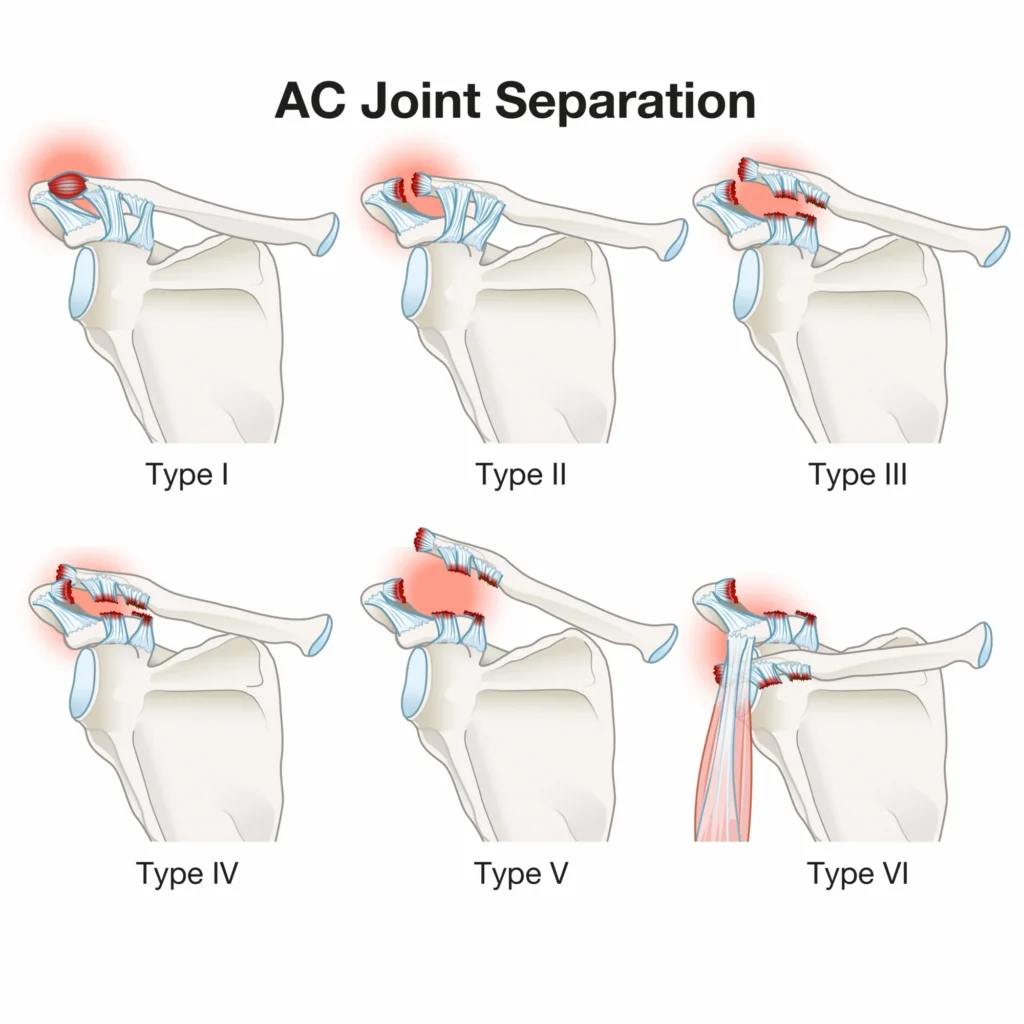
Orthopedic surgeons can classify AC joint separations on a scale from grade I to grade VI, based on how much ligament damage has occurred and how far the collarbone has shifted.
Grade I and grade II injuries are sprains. The ligaments stretch or partially tear, but the joint stays mostly in its normal position. Grade III involves a complete tear of both ligament groups, and the collarbone typically sits noticeably higher than usual, creating a visible bump. Grades IV, V, and VI are less common and more severe. The collarbone may shift backward into the muscle behind it or displace significantly upward, often tearing muscle attachments along the way.
X-rays, sometimes taken while the patient holds a light weight to stress the joint, usually confirm the grade. In my experience, the physical exam tells me almost as much as the imaging does. How much the collarbone moves when I press on it, and whether the ligaments feel intact under my hands, shapes a lot of my thinking before the X-ray even comes back.
AC joint separations are common in active adults, particularly those who cycle, play contact sports, or work in physically demanding jobs where a fall onto the shoulder is more likely. Men are affected more often than women, and younger patients tend to make up a larger share of the higher-energy injuries I see, simply because they are more likely to be on a bike, a field, or a roof when the fall happens.
What I See in My Patients
Most of the AC joint separations I treat come from one of two mechanisms. The first is a straightforward fall, off a bike, off a ladder, or on ice, where the patient lands hard on the tip of the shoulder with the arm tucked in at their side. These are covered in more detail in my post on shoulder injuries after a fall.
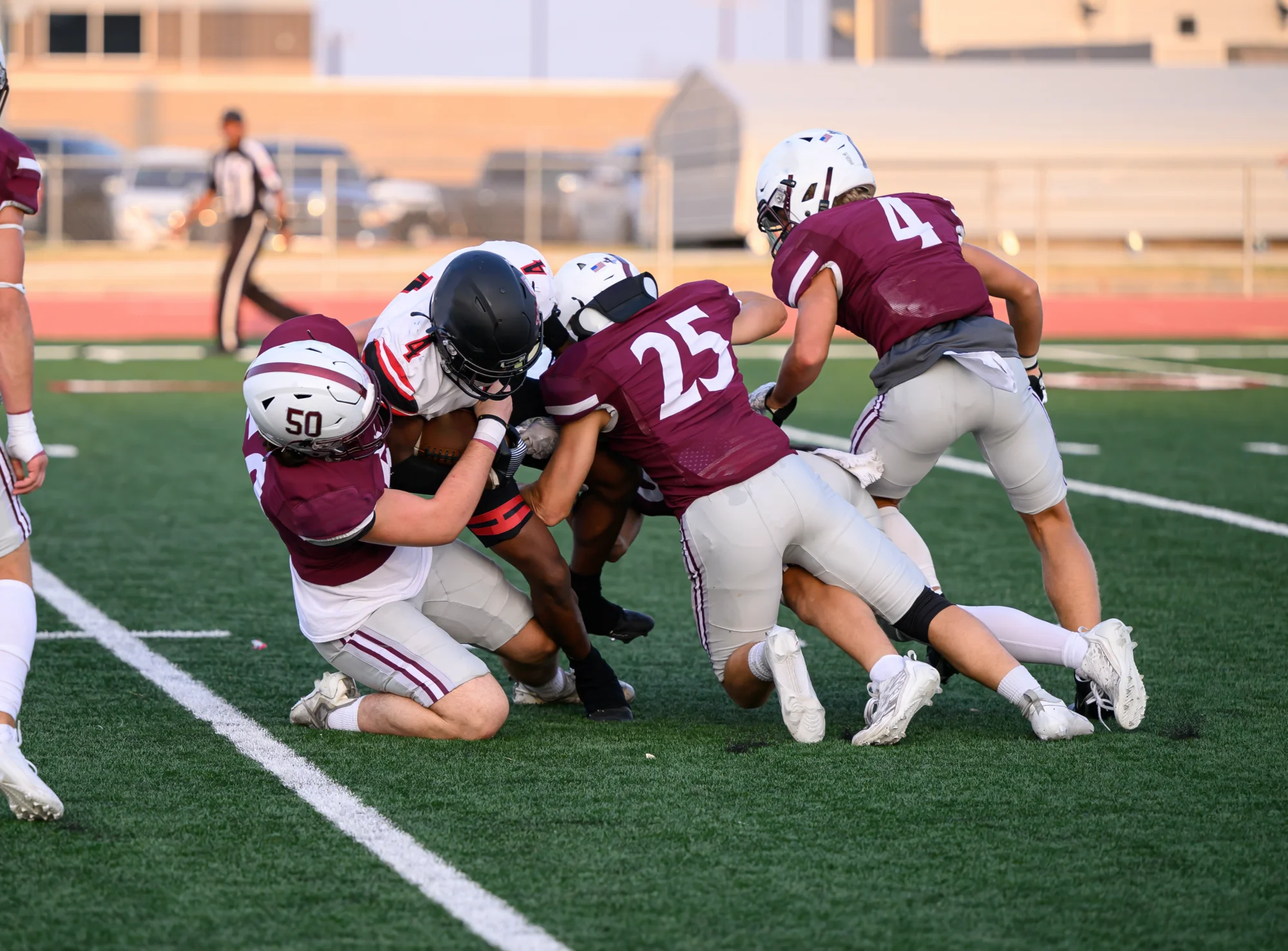
The second mechanism is contact sports, and I see a steady stream of these from local football and hockey players through the fall and winter.
Younger athletes tend to want to return to play faster than their ligaments are ready for, and I understand the pressure. A season only lasts so long. But I have watched patients push back into contact too early on a grade III injury and end up with a chronically prominent, unstable joint that becomes a bigger problem than the original one. I would rather have an honest conversation up front about the timeline than manage the consequences of rushing it later.
My Approach to Treatment
For grade I and grade II AC joint separations, I do not operate. These typically respond well to a short period of rest, ice, a sling for comfort during the first week or two, and a gradual return to motion and strengthening under a physical therapist’s guidance. Most patients are back to normal daily activity within a matter of weeks.
Grade III is where the conversation gets more individualized. In many cases, we can still start with non-surgical treatment, particularly if the patient is not a manual laborer or overhead athlete. If pain and instability persist after a committed course of physical therapy, or if a patient’s job or sport places heavy demand on the shoulder, I will discuss surgical stabilization at that point.
Grades IV through VI usually need surgical repair. The amount of displacement and soft tissue damage at these levels makes it unlikely the joint will settle into a stable position on its own. Surgery typically involves reconstructing the torn ligaments, sometimes using a tendon graft, to restore the normal relationship between the collarbone and shoulder blade.
Pain control matters throughout this process too. In the first days after injury, ice, a sling for comfort, and an appropriate pain medication usually keep symptoms manageable while the ligaments begin healing. If pain suddenly worsens rather than gradually easing, or if the shoulder starts to look more deformed than it did initially, that is worth a call to my office rather than waiting for the next scheduled visit.
Recovery Expectations by Grade
Recovery timelines vary by grade and by whether surgery becomes part of the treatment plan. It can also vary between patients, but here are some general guidelines:
Patients with grade I or grade II injuries treated conservatively often see meaningful improvement within two to four weeks and typically return to full activity, including sports, within about six to eight weeks.
For grade III injuries managed without surgery, recovery generally takes a bit longer, in the range of six to twelve weeks before returning to more demanding activity, since the joint has less inherent stability to lean on while healing.
When surgical stabilization is needed, whether for a higher-grade injury or a grade III that did not improve conservatively, recovery follows a longer arc. Patients usually wear a sling for the first several weeks to protect the reconstruction, with structured physical therapy introduced gradually as healing allows. Return to contact sports or heavy manual labor after surgical stabilization commonly takes around four to six months, and I ask patients to respect that timeline even once the shoulder starts feeling good sooner.
A few signs during recovery deserve prompt attention rather than a wait-and-see approach: increasing redness or drainage around a surgical incision, fever, new numbness that was not present at the initial injury, or pain that escalates instead of gradually improving. Consistent follow-through with activity restrictions and physical therapy remains one of the more effective ways to protect the healing ligaments and lower the risk of a poor outcome.
Summary
An AC joint separation covers a wide range of severity, from a mild ligament sprain that resolves in a few weeks to a significant dislocation that benefits from surgical reconstruction. Grading the injury accurately, through both examination and imaging, is what allows me to build a treatment plan that fits the specific injury rather than a one-size-fits-all approach. If you have shoulder pain and a visible bump near your collarbone after a fall or collision, I encourage you to schedule an evaluation so we can determine the grade and get you started on the right path toward recovery.
Frequently Asked Questions
Can an AC joint separation heal without surgery?
Many can. Grade I and grade II separations typically heal well with rest, activity modification, and physical therapy. Even some grade III injuries do reasonably well without surgery, though this depends on the patient’s activity level and how symptoms respond to conservative treatment.
How long does it take to return to sports after an AC joint separation?
It depends on the grade and treatment approach. Mild separations may allow a return to sports within six to eight weeks. Higher-grade injuries treated surgically may require around four to six months before contact sports are considered safe. Timelines vary between patients.
What is the difference between an AC joint separation and a shoulder dislocation?
An AC joint separation involves the ligaments connecting the collarbone to the shoulder blade. A shoulder dislocation involves the ball-and-socket joint, where the upper arm bone comes out of the socket. They can sometimes occur together, but they affect different structures and are treated differently.
Will I always have a bump on my shoulder after an AC joint separation?
Higher-grade separations can leave a visible or palpable bump where the collarbone sits slightly elevated, even after the injury has healed. This is usually a cosmetic finding rather than a functional problem.
Can I still work out or lift weights with an AC joint separation?
Light, pain-free movement may be encouraged early on to prevent stiffness, but heavier lifting and overhead activity usually need to wait until the ligaments have had adequate time to heal. I typically guide patients through specific milestones during follow-up visits rather than giving a single blanket timeline, since every separation responds a little differently.