

Medically reviewed by Jeff Zhao, DO | Reviewed August 2026
Shoulder pain at night is one of the most common complaints I hear from patients in my Sunnyvale and Kaufman offices, and it is often what finally gets someone to schedule an appointment. The daytime ache they had been living with becomes something they cannot ignore once it starts waking them up at 2 a.m. In this post, I want to walk through why shoulder pain at night tends to be worse than daytime pain, what conditions commonly cause it, and how I think through the workup when a patient describes this pattern.
Key Takeaways
- Shoulder pain at night is a very common symptom, and by itself it does not point to one specific diagnosis.
- Rotator cuff problems, impingement, frozen shoulder, and arthritis are among the most frequent causes I see.
- Sleep position may make an existing problem feel worse, even when it is not the underlying cause.
Why Night Pain Feels Worse
Several patients have asked me some version of the same question: why does my shoulder feel fine most of the day and then ache the moment I lie down? Part of the answer is mechanical, and it comes down to load. When you are upright, the shoulder is essentially a non-weight bearing joint, where the arm hangs and the joint carries very little. Once you lie down, gravity changes that. Any underlying structural damage that stays quiet under a light load tends to become a lot more prominent.
There may also be a physiological piece to this. Inflammatory markers in the body tend to fluctuate over a 24-hour cycle, and many patients with joint and tendon problems report that pain intensifies in the evening and overnight. This does not mean anything is more damaged at night than during the day. It usually means the same underlying problem is simply harder to ignore once you are still.
Common Causes of Shoulder Pain at Night
Night pain shows up across a range of shoulder conditions, and I want to walk through a few of the ones I see most often rather than list every possibility.
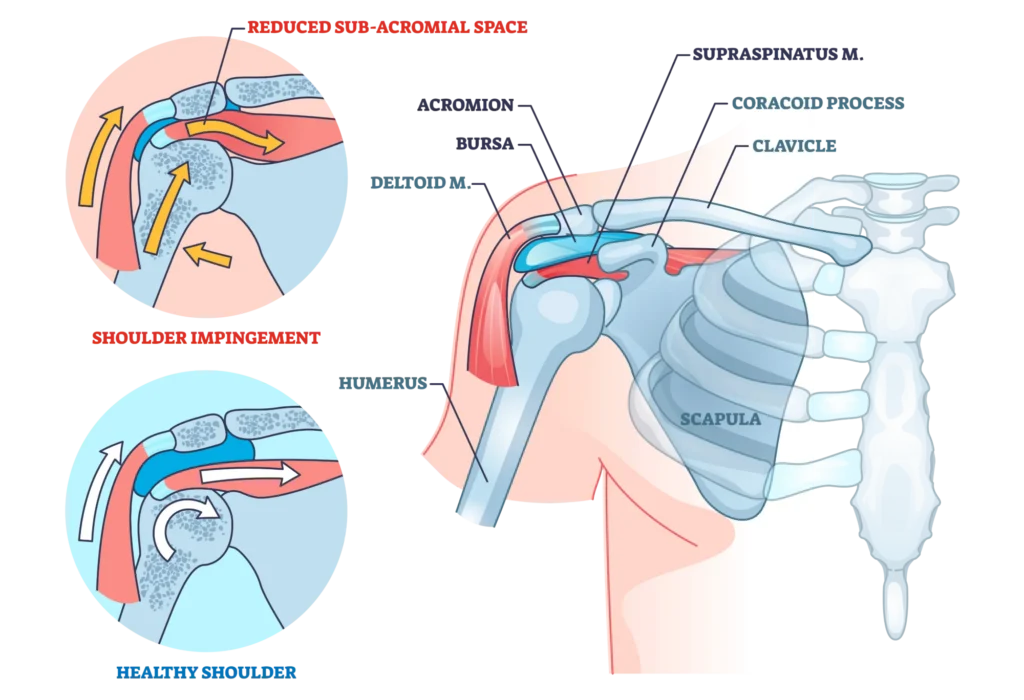
Rotator cuff tendinopathy and rotator cuff tears are among the most frequent causes. Pain often worsens with overhead reaching and lifting during the day, then intensifies at night, particularly when lying on the affected shoulder. Shoulder impingement, where the rotator cuff tendons get compressed during certain movements, follows a similar pattern and can be difficult to distinguish from a cuff tear without imaging.
Frozen shoulder, medically known as adhesive capsulitis, is another common culprit. Night pain is frequently one of the earliest symptoms, sometimes appearing before patients notice significant stiffness.
Shoulder arthritis can also produce a deep, aching night pain, particularly in patients who also notice morning stiffness or grinding with movement. And in some cases, the problem is not the shoulder joint at all, but rather how a patient is positioned in bed, compressing the joint or the surrounding soft tissue for hours at a time without realizing it.
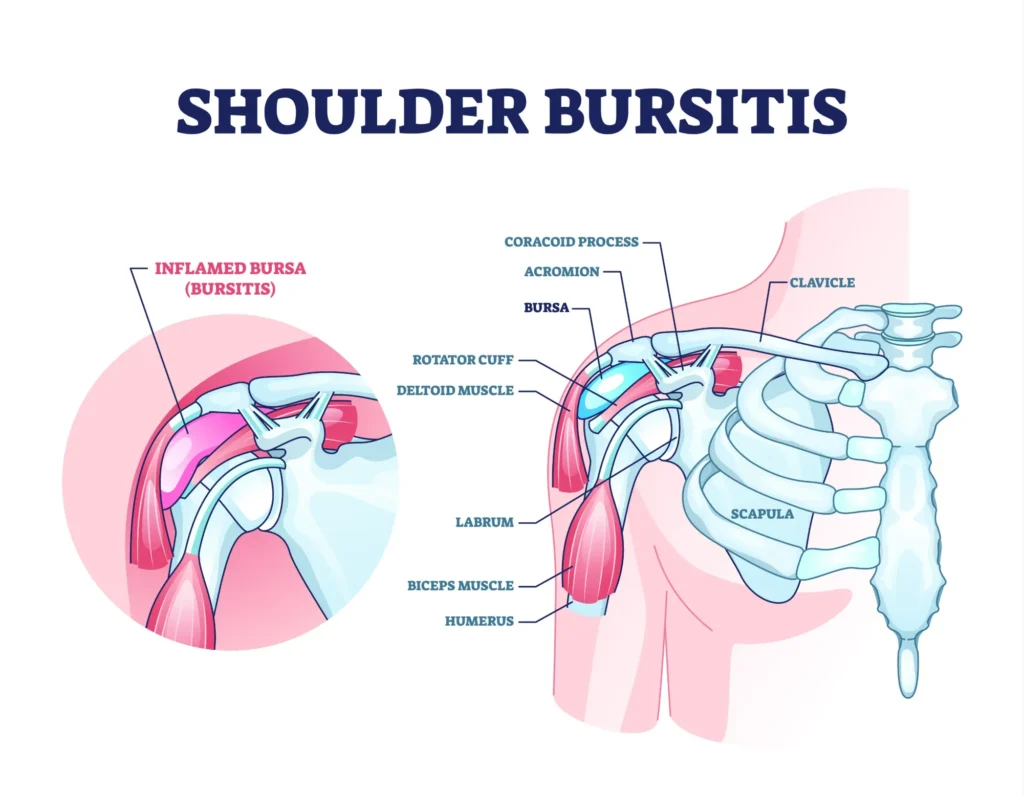
Bursitis is worth mentioning too. The shoulder contains small fluid-filled sacs called bursae that reduce friction between moving parts, and when one becomes inflamed, it often produces pain that is sharp with movement during the day and a persistent, throbbing ache once you lie down on it at night. Bursitis frequently overlaps with impingement, since the same crowded space in the shoulder tends to irritate both structures at once.
When Night Pain Deserves Prompt Attention
Most of the night pain I evaluate is not an emergency, but a few patterns move a patient higher on my list. Pain following a specific injury or fall, sudden significant weakness that was not there before, or pain accompanied by fever or redness around the joint all warrant a sooner evaluation rather than a wait-and-see approach. I also pay closer attention when a patient describes pain that has rapidly worsened over just a few days, since that trajectory is different from the slow, grinding onset I see with most chronic shoulder conditions.
What I See in My Patients
In my practice, I have noticed that patients tend to describe night pain in one of two ways, and the distinction is genuinely useful to me. Some describe a sharp pain that wakes them the moment they roll onto the affected side. Others describe a duller, more constant ache that is present regardless of position, but simply feels louder at night. The first pattern points me more toward a mechanical problem like a rotator cuff tear or impingement. The second nudges me toward something more diffuse, like arthritis or an early frozen shoulder.
I also see a fair number of patients who have already tried changing their sleep position, propping themselves up, or switching to their other side, before they ever get to my office. That effort tells me something useful too. If repositioning genuinely relieves the pain, I lean toward a mechanical or positional explanation. If nothing they try in bed makes a real difference, I start thinking harder about an inflammatory or structural cause that needs a closer look.
My Approach to Treatment
I do not think every patient with night shoulder pain needs an MRI on day one. For many patients, a good history and physical exam, combined with basic X-rays, gives me enough information to start a reasonable treatment plan and watch how the shoulder responds.
My initial approach usually includes activity modification, a period of anti-inflammatory medication when appropriate, and a referral to physical therapy focused on the specific movement pattern that seems to be driving the irritation. I am also direct with patients about sleep positioning. Sleeping on your back with a small pillow supporting the affected arm, or on the unaffected side with a pillow hugged in front of you for support, reduces pressure on an irritated shoulder for a lot of people. Ice tends to help more than heat in the first week or two of an acute flare, though some patients find a warm shower before bed loosens things up enough to fall asleep more easily. Either approach is reasonable as long as it is not replacing an actual evaluation for pain that keeps returning.
If symptoms persist despite several weeks of a consistent, well-run conservative program, or if the exam and history point strongly toward a structural problem like a significant rotator cuff tear, I move toward imaging and a more targeted plan, which may include an injection or, less commonly at that stage, surgery.
I would rather give a well-designed conservative program a real chance to work than move straight to more invasive options when the evidence does not clearly call for it.
Summary
Shoulder pain at night is common, but it is rarely random. Rotator cuff problems, impingement, frozen shoulder, and arthritis all tend to disrupt sleep in slightly different ways, and how you describe the pattern of your pain gives me real diagnostic information. Most causes respond well to a structured, non-surgical starting plan, though some do eventually need imaging or a procedure to fully resolve. If shoulder pain has been costing you sleep for more than a couple of weeks, I encourage you to schedule a visit so we can figure out what is actually driving it and get you back to sleeping through the night.
Frequently Asked Questions
Is shoulder pain at night always a sign of something serious?
Not necessarily. Night pain is a very common symptom across a wide range of shoulder conditions, many of which respond well to conservative treatment. That said, pain that persists for more than a couple of weeks, or that is accompanied by significant weakness, is worth having evaluated.
What sleep position is best for shoulder pain?
Many patients find relief sleeping on their back with the affected arm supported by a pillow, or on the unaffected side while hugging a pillow for support. The right position often depends on the specific cause of the pain, so what helps one patient may not help another.
Can a pinched nerve in the neck cause shoulder pain at night?
It can. Neck-related nerve irritation can sometimes mimic shoulder pain, including pain that worsens at night. Part of a thorough evaluation includes ruling out the neck as a source, especially when shoulder-specific tests and imaging do not fully explain the symptoms.
How long should I try home treatment before seeing a doctor?
If rest, activity modification, and over-the-counter anti-inflammatory medication have not meaningfully improved your symptoms after a couple weeks, that is a reasonable point to have the shoulder evaluated rather than continuing to wait it out.