

Medically reviewed by Jeff Zhao, DO | Reviewed July 2026
One minute a patient is snowboarding, tackling a defender, or catching themselves after a fall, and the next their arm is hanging in a position that looks wrong. What happens in the first 24 hours after a shoulder dislocation may help shape how well that shoulder recovers, which is why I want to walk through exactly what I tell my own patients in that window, from the moment of injury through that first follow-up visit.
Key Takeaways
- A shoulder dislocation happens when the ball of the humerus slips out of the shoulder socket, usually from a fall, collision, or awkward reach.
- You should not try to put a dislocated shoulder back into place yourself. Get to an emergency room or urgent care for a proper reduction.
- Following up with an orthopedic surgeon within the first one to two weeks helps determine whether physical therapy alone will be enough or whether the shoulder needs surgical stabilization.
What Actually Happens When a Shoulder Dislocates
The shoulder is built for motion more than it is built for stability, and that tradeoff is exactly why dislocations happen here more than almost anywhere else in the body. The joint works like a golf ball resting on a tee: the round head of the humerus sits against a shallow socket on the shoulder blade called the glenoid. Ligaments, the labrum, and the rotator cuff all work together to keep that ball centered.
When a fall, a collision, or a forceful twisting motion pushes the arm beyond what those structures can control, the humeral head slides out of the socket. Most of the dislocations I see in my Sunnyvale and Kaufman offices are anterior dislocations, meaning the ball slips forward and down out of the socket. That direction of injury is common enough that if a patient tells me their arm “popped out” during a fall onto an outstretched hand, I already have a good guess at what I will find on exam.
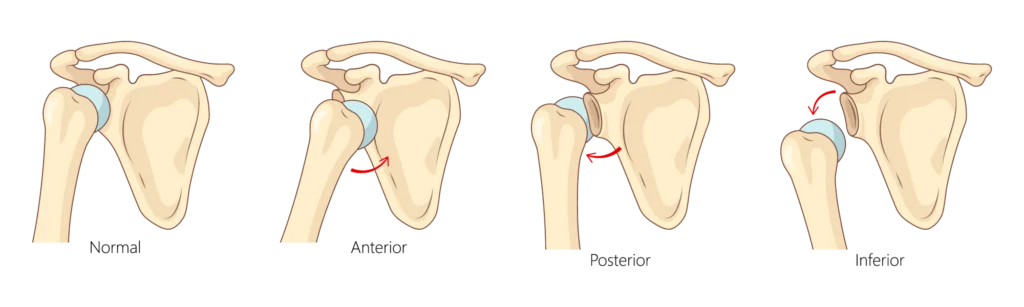
Recognizing a Dislocation in the First 24 Hours
A dislocated shoulder rarely looks subtle. The arm often hangs at an awkward angle, and the normally rounded contour of the shoulder can appear squared off instead. Pain is usually severe enough that the patient will not, and often cannot, move the arm at all.
Swelling and bruising tend to develop quickly, and it is common for patients to describe numbness or tingling running down into the hand, which happens when swelling or the position of the bone puts pressure on nearby nerves. Muscle spasms around the joint are common too, as the surrounding muscles try to guard against further movement.
I tell patients that the combination of visible deformity plus an inability to move the arm is usually enough for me to suspect a dislocation before I even touch the shoulder. The exam and X-ray confirm it.
What to Do Right Away
If you suspect a shoulder dislocation, the most important thing you can do in the first 24 hours is get to an emergency room or urgent care rather than trying to manage it at home. I understand the instinct to try to “pop it back in,” especially if this is not a person’s first dislocation, but I do not recommend self-reduction. Without proper positioning and often some form of pain control, attempting to relocate the joint yourself can worsen damage to the labrum, the rotator cuff, or the nerves running through the area.
While you are waiting for care, keep the arm as still as possible. A makeshift sling, even a folded shirt, can help support the weight of the arm and reduce pain until you reach a medical facility. Ice applied to the shoulder for short periods may help control swelling and discomfort.
Once the joint has been reduced by a medical provider, most patients are placed in a sling and referred for follow-up. This is the point where I want patients calling my office in Sunnyvale or Kaufman, because the choices made in that first week or two set the direction for the rest of recovery.
What I See in My Patients
The dislocations I treat tend to split into a few recognizable groups. The first is younger athletes, often in their teens or twenties, who dislocate playing football, wrestling, or during a fall while snowboarding or mountain biking. I snowboard myself, and I understand exactly the kind of fall that puts a shoulder in a bad position.
The second group is older patients who dislocate from a fall at home or from tripping on an uneven sidewalk. Their injuries tend to come with a different set of concerns, including a higher chance of an associated rotator cuff tear, since the tendons of the rotator cuff naturally weaken with age.
I am direct with the young, athletic group about one thing in particular: a first-time dislocation under the age of twenty-five carries a real risk of happening again, sometimes more than half the time depending on the sport and the specific injury pattern. I do not think every young patient needs surgery after a single dislocation, but I also do not think it is fair to tell a nineteen-year-old football player that a sling and a few weeks of rest will definitely be the end of it.
My Approach to Treatment
My first priority after a dislocation is always getting the joint safely back into place. After reduction, I typically keep patients in a sling for three to four weeks to let the initial injury settle down and protect the shoulder from an early repeat dislocation.
Physical therapy begins once that immobilization period ends, focused on restoring motion first and rebuilding strength second. I have found that patients who treat those early therapy sessions seriously, rather than skipping them because the shoulder “feels fine,” end up with a more stable joint months down the road.
Surgery is not automatic after a first dislocation, and I want to be clear about that. I generally reserve surgical stabilization for patients with recurrent dislocations, for those with significant structural damage found on imaging, such as a large Bankart tear, or for young athletes returning to high-risk contact sports who I believe are unlikely to tolerate a second injury well. For patients who fit those criteria, I discuss the arthroscopic stabilization options in detail, including what the surgery involves and what recovery looks like, before we make a decision together.
What Recovery Looks Like
For a first-time dislocation managed without surgery, many of my patients are looking at roughly three months of structured rehabilitation before they feel confident using the shoulder normally again. That timeline includes the initial sling period, a phase of regaining motion, and then a longer stretch of strengthening work.
Patients who undergo surgical stabilization generally need closer to six months before I clear them to return to contact sports or activities with a high risk of re-injury. That may sound like a long runway, but the shoulder tissue needs real time to heal and the surrounding muscles need real time to relearn how to protect the joint.
Summary
A shoulder dislocation is painful and frightening in the moment, but what happens in the first 24 hours after a shoulder dislocation and the weeks that follow matter. Getting the joint properly reduced, protecting it appropriately, and following through with rehabilitation are the pieces that actually determine how the shoulder functions a year from now. If you have dislocated your shoulder recently, or if you dislocated one months ago and it still does not feel stable, I encourage you to schedule a consultation at my Sunnyvale or Kaufman office so we can look at exactly what is going on and build a plan around your activity level and goals.
Frequently Asked Questions
Can I go back to sports right after my shoulder feels better?
I generally do not recommend returning to contact sports as soon as pain and swelling improve. The ligaments and soft tissue around the joint need time to heal, even after the shoulder starts to feel more normal. Returning too early raises the risk of another dislocation.
Do all shoulder dislocations require surgery?
No. Many first-time dislocations, especially in older patients or those without significant structural damage, respond well to a period of immobilization followed by physical therapy. Surgery is typically reserved for recurrent dislocations or cases with significant associated injury.
How do I know if I have a dislocated shoulder or just a bad sprain?
A true dislocation usually causes visible deformity, an inability to move the arm at all, and severe pain that does not improve with rest. If you are unsure, it is safest to be evaluated promptly rather than waiting to see if symptoms resolve.
What is a Bankart tear and how does it relate to dislocation?
A Bankart tear involves the labrum, the ring of cartilage that helps stabilize the shoulder socket. It commonly occurs during a dislocation, particularly a first-time dislocation in a younger patient, and can contribute to a higher risk of the shoulder dislocating again.
How soon after a dislocation should I see an orthopedic surgeon?
I recommend a follow-up visit within one to two weeks of the initial injury. That visit allows me to assess the shoulder’s stability, review imaging if needed, and outline a rehabilitation plan tailored to the patient’s age and activity level.