

Medically reviewed by Jeff Zhao, DO | Reviewed July 2026
Shoulder impingement syndrome is one of the most common reasons patients walk into my Sunnyvale and Kaufman offices holding their arm a little differently than usual. So, what is shoulder impingement syndrome, exactly? In simple terms, it is what happens when the tendons of the rotator cuff get pinched inside a tight space every time you lift your arm. I want to walk through why that pinching happens, what it tends to feel like, and what I do about it in my practice.
Key Takeaways
- Shoulder impingement syndrome occurs when rotator cuff tendons become compressed between bones during overhead or reaching motions.
- Pain that worsens with overhead activity and disturbs sleep on the affected side is the most recognizable pattern.
- Repetitive overhead work and sports, such as painting, warehouse work, swimming, and tennis, raise the risk significantly.
- Arthroscopic surgery may be available for patients who do not improve after a genuine trial of conservative treatment.
What Is Happening Inside the Shoulder
The space above the rotator cuff tendons and below the tip of the shoulder blade, called the acromion, is not particularly generous to begin with. That space, known as the subacromial space, is where the supraspinatus tendon and the subacromial bursa live. Every time you raise your arm overhead, that space narrows slightly. Impingement is one of several shoulder conditions I treat that trace back to this same crowded space.
In a healthy shoulder, the tendon glides through without much trouble. In an impinged shoulder, something is narrowing that space further or irritating the tendon enough that it swells, and a swollen tendon takes up more room in a space that already had very little to spare. Changes such as bone spurs, acromion shape, tendon thickening, or repetitive loading may contribute to irritation in some patients.
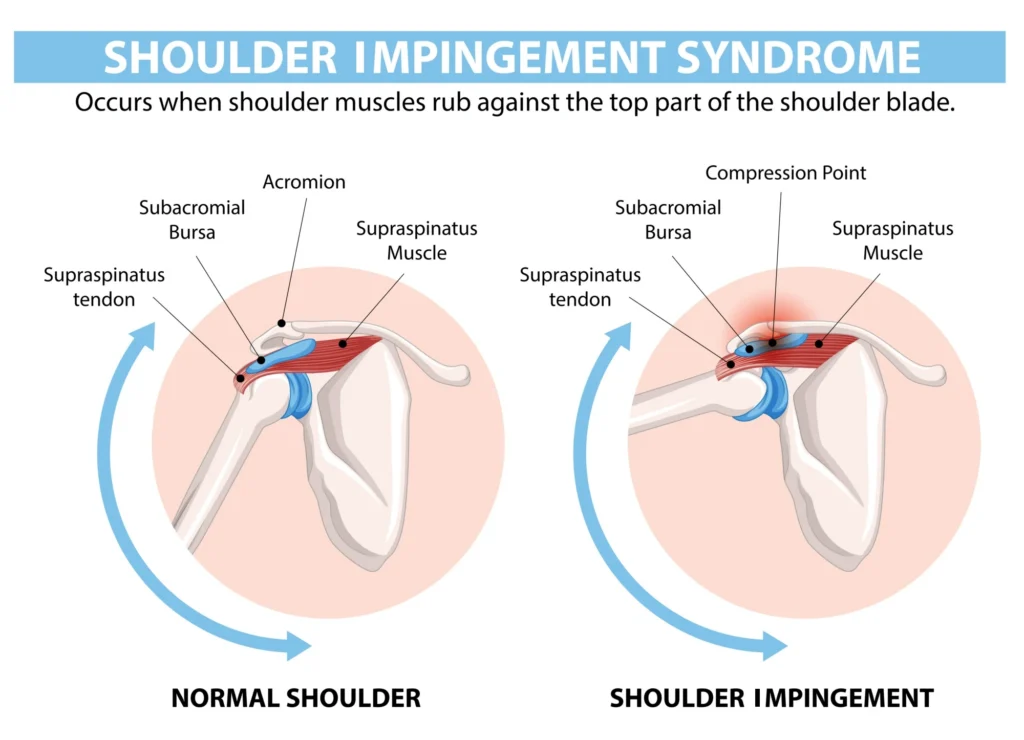
I explain it to patients this way: think of a door that used to close smoothly and now catches on the frame every time. The door has not changed size much, but something about the frame or the door itself has narrowed the gap. The shoulder works the same way.
How Shoulder Impingement Syndrome Develops
Impingement can build gradually or announce itself fairly quickly, depending on the cause. Repetitive overhead motion is the most common driver I see. Painters, warehouse workers who reach onto high shelves all day, and electricians working overhead are frequent patients of mine, and so are swimmers, tennis players, and volleyball players whose sport demands the same motion over and over.
Posture plays a role too. Rounded shoulders and a forward head position, common for anyone who spends the day at a desk or driving, may reduce the space available to the rotator cuff even without heavy overhead activity. Age-related changes to the tendons and the shape of the acromion add another layer, which is part of why impingement becomes more common as people move into their forties and fifties.
I windsurf myself, and it is an overhead-heavy sport in its own right. I have an appreciation for how much repetitive strain the shoulder tolerates before it starts complaining, and also for how quickly that complaint can turn into a real problem if it gets ignored.
Not every risk factor here is something a patient can simply change. The shape of the acromion is determined by anatomy, not habit, and some patients are working against a naturally tighter subacromial space no matter how good their posture or technique is. I think that distinction matters. It is not always a matter of doing something wrong.
Recognizing the Symptoms
The signature symptom of shoulder impingement syndrome is pain with overhead reaching, whether that is putting away dishes, reaching behind the back to fasten clothing, or lifting something onto a shelf. Many patients also describe pain that flares up at night, particularly when lying on the affected shoulder, which disrupts sleep more than people expect.
A third pattern I watch for is a dull ache that radiates down the outer arm rather than staying localized to the top of the shoulder. Patients sometimes assume that radiating pain means the problem is somewhere else entirely, but it is a fairly typical impingement presentation.
Weakness tends to show up later, usually after the pain has been present for a while and the patient has started unconsciously avoiding overhead motion. By the time someone tells me they have simply stopped reaching for the top shelf, the impingement has usually been progressing for months.
Rest tends to bring temporary relief, which is part of what makes this condition tricky. Patients feel better over a weekend away from the aggravating activity, return to work or training on Monday, and the pain comes right back.
What I See in My Patients
The patients I see with impingement in Sunnyvale and Kaufman fall into a few groups. The largest by far is working adults in physically demanding jobs, people whose livelihood depends on using their arms overhead repeatedly, day after day. These patients often push through symptoms far longer than I would recommend because taking time off is not simple for them, and by the time they come in, the tendon has been irritated for months.
The second group is recreational and competitive athletes, particularly swimmers and racquet sport players, whose shoulders take on a repetitive load that most daily activities never approach. I tend to see this group earlier, in many cases because a coach or trainer noticed a change in performance before the athlete fully registered the pain.
A pattern I have noticed across both groups is that the patients who do best are not necessarily the ones with the mildest impingement. They are the ones who actually do the physical therapy exercises at home, not just during their appointments.
My Approach to Treatment
I do not jump to surgery for shoulder impingement, and I tell patients that directly during their first visit. My default starting point is activity modification paired with a structured physical therapy program focused on repositioning the shoulder blade and strengthening the muscles that control it. Done consistently, this approach can create more working room for the irritated tendon without ever opening the shoulder up.
Anti-inflammatory medication can help take the edge off pain during that process, and for patients whose discomfort is limiting how well they can participate in therapy, I will sometimes recommend a corticosteroid injection into the subacromial space to calm things down enough to make real progress in rehab.
When symptoms persist despite a course of consistent conservative treatment, I may discuss arthroscopic surgery to remove the inflamed tissue and create additional space for the rotator cuff.
Summary
Shoulder impingement syndrome is uncomfortable, but it responds well to treatment in the large majority of the patients I see, especially when it gets addressed before months of compensation patterns set in. If overhead reaching has started to hurt or you have noticed yourself avoiding it altogether, I encourage you to schedule an evaluation at my Sunnyvale or Kaufman office so we can figure out exactly what is narrowing that space and build a plan to fix it.
Frequently Asked Questions
Is shoulder impingement the same thing as a rotator cuff tear?
No, though the two conditions are related. Impingement involves compression and irritation of the rotator cuff tendons, while a rotator cuff tear involves an actual tear in the tendon tissue. Untreated impingement may contribute to a tear developing over time, which is part of why early treatment matters.
Can shoulder impingement go away on its own?
Mild cases sometimes improve with rest and activity modification alone, but many patients benefit from a structured physical therapy program rather than waiting it out. Continuing the activities that caused the impingement without changes tends to prolong symptoms.
Do I need an MRI to diagnose shoulder impingement?
Not always. A thorough history and physical exam often provide enough information to make the diagnosis and start treatment. I may recommend imaging, including X-rays or an MRI, when symptoms are severe, when there are signs of a possible rotator cuff tear, or when a patient is not improving as expected.
What happens if shoulder impingement is left untreated?
Ongoing impingement can lead to persistent inflammation and, in some cases, progression to a rotator cuff tear. Prolonged pain also tends to cause people to compensate with poor mechanics, which can create secondary problems elsewhere in the shoulder or neck.